Gemini Notebook is a useful research assistant for creators working from a collection of documents, links or recordings. It helps you question that material and follow citations back to sources. Its value depends on the evidence you supply and the checks you make before publishing.
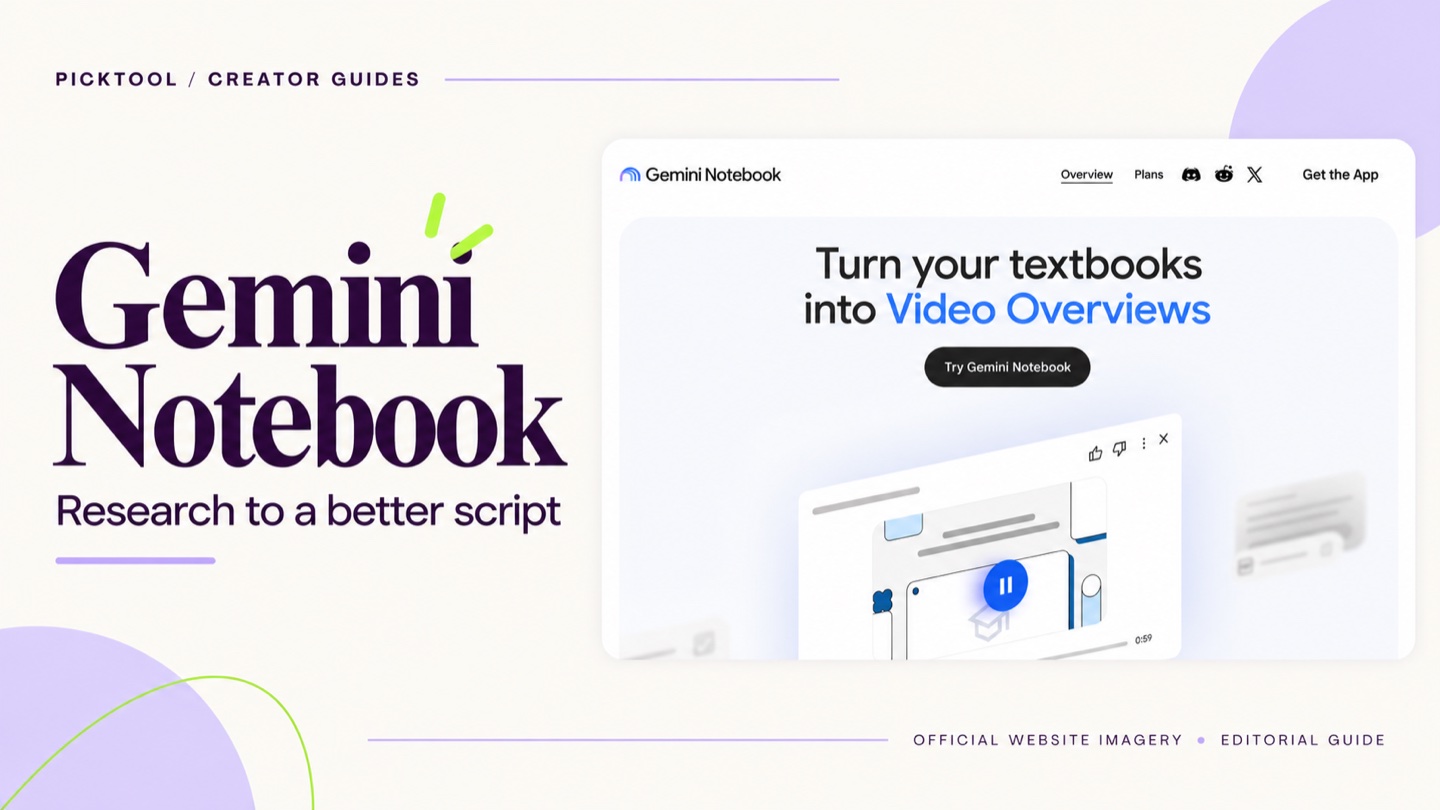
An interesting video idea usually arrives before a tidy research folder. You have a report, a few interviews, a saved article and a long list of questions. Gemini Notebook gives that material a place to become a working research project. Google’s current homepage uses the Gemini Notebook name; the older NotebookLM name still appears in directories and tutorials. This article uses the name shown on the official site. [1]
For a creator, the most useful question is whether it helps produce a script you can defend. The product is worth considering when you already have material to examine and want a more practical way to ask questions across it. A convincing answer is still a starting point for your own verification.
Why the source collection matters
Google describes Gemini Notebook as an assistant built around sources. You can bring in supported material, ask questions and use citations to inspect where an answer came from. It also offers generated study and presentation formats, including Audio Overviews. These features make a large collection easier to approach, but they do not certify its accuracy. [2]
Imagine preparing an explainer about the cost of making a weekly podcast. Your source set might contain a recording service's plan page, invoices you are allowed to use and notes from two producers. Ask what each source says about recurring costs. Then ask where their assumptions differ. That produces a more useful research question than asking for a generic list of the best podcast tools.
Keep the collection focused enough that you understand why every item belongs. A manufacturer brochure, an independent test and a personal interview can all be valuable, but they serve different purposes. Label them clearly. Otherwise, a fluent synthesis can make unlike kinds of evidence sound equally authoritative.
A workflow for a source backed video script
Begin with the question your audience needs answered. For example, ask whether a solo creator needs a separate recorder for remote interviews. Assemble a small collection that speaks directly to that question, including the relevant product documentation and your own interview notes.
- Ask for an outline that separates established facts, vendor claims and unresolved questions. Keep those labels in your working notes.
- Open the cited source for every number, quotation and consequential claim. Check the date and the passage around it.
- Build the script around the verified material, then add your own explanation, examples and editorial judgment.
An Audio Overview can be useful while you are deciding which parts of a collection deserve attention. For a finished video, go back to the original passages. You want the script to reflect the evidence, rather than merely repeat another generated summary of it.
Citations are a route back to evidence
A citation tells you where to look. You still need to establish whether that passage supports the sentence you intend to publish. Check whether a result applies to the same country, product version and period you are discussing. A statement about an annual plan, for instance, may be misleading when presented as a month-to-month price.
Be especially careful when several uploaded sources repeat the same original announcement. Five articles based on one press release do not create five independent confirmations. Follow important claims back to the first source whenever possible.
Pricing and privacy need an account specific check
Google offers free access and higher limits through eligible paid plans. Its help pages distinguish account types and additional access levels, so check the plan attached to the account you will actually use. A paid Google subscription is not a blanket promise of unlimited usage. [3]
For personal accounts, Google's privacy documentation says data is not used to train Gemini Notebook unless you provide feedback; feedback can allow review of associated context. Workspace and education accounts have their own conditions. That distinction matters if your collection includes a client brief or unpublished interview. [4]
Before uploading private material, confirm that you have permission to share it with the service. Removing unnecessary personal details is a sensible first step, but it does not replace a client's confidentiality requirements. Keep a separate copy of the original sources and your final notes.
When another tool makes more sense
A general writing assistant may be more convenient for trying unrelated hooks or rewriting a paragraph when there is no defined evidence collection. A reference manager is worth considering when formal citations and a long-term academic library are the central job. Gemini Notebook is especially relevant between those stages: you have a bounded research project and need to understand it well enough to explain it.
For a creator who rarely uses external sources, a new notebook for every short post may add unnecessary work. Start with one project that has enough material to justify the setup. Evaluate the result by whether you can locate and explain the evidence behind your script, rather than by how polished the first generated answer sounds.
Picktool editorial judgment
Shortlist Gemini Notebook for explainers, interviews and research-heavy tutorials. The strongest reason to try it is the opportunity to keep questions, sources and working answers together. The deciding test is simple: give it a small collection you understand, ask questions with known answers and inspect the citations. We have not run that benchmark for this article, so this is a documentation-based assessment.
How we assessed this tool
Documentation-based editorial assessment using the official sources listed below. We have not benchmarked the tool, verified output quality, or tested a paid subscription. Example workflows describe what to try; they are not reported test results.
Questions & answers
Is Gemini Notebook the same product as NotebookLM
It is the current name of the product Google previously called NotebookLM. Older links and tutorials may still use the former name. [1]
Can I use a generated answer directly in a script
You can use it as draft material, but verify the supporting passages, facts and permissions before publication. A citation does not remove the need for editorial review.
Is it useful without a large source library
A small, relevant collection can be enough for a focused project. The important test is whether the material can answer the question you are researching.
Sources & check dates
- 1. Google official Gemini Notebook homepage and current product name ↗ · Checked 2026-10-26
- 2. Google Help introduction and supported research workflow ↗ · Checked 2026-10-26
- 3. Google Help upgrades and account limits ↗ · Checked 2026-10-26
- 4. Google Help privacy and personal account data use ↗ · Checked 2026-10-26