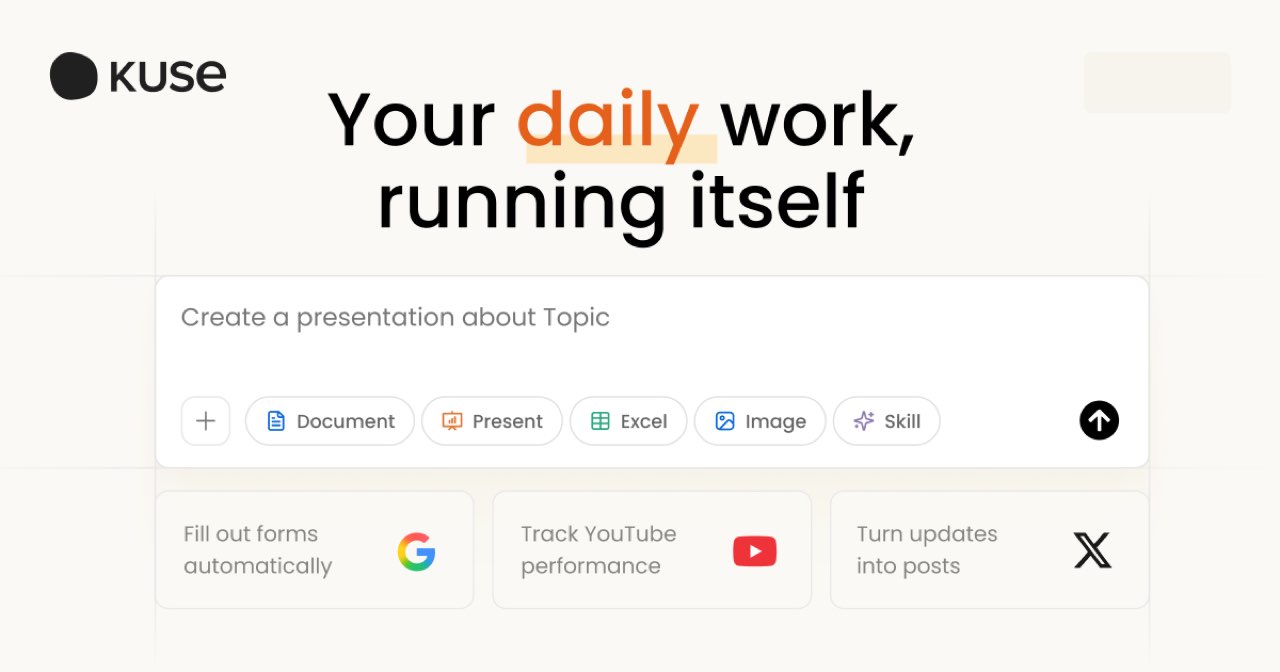
Kuse is worth considering when you need to work across several source files and turn them into a document, presentation or another structured result. For a creator, the sensible first use is a research brief with a visible evidence trail. The output should make source checking easier rather than hide it behind fluent writing.
A research folder can be full of useful material and still fail to produce a useful script. The problem is often the handoff between collecting information and deciding what the audience should learn. Kuse approaches that handoff through an AI workspace built around files, projects and generated deliverables.
Kuse is worth considering when you need to work across several source files and turn them into a document, presentation or another structured result. For a creator, the sensible first use is a research brief with a visible evidence trail. The output should make source checking easier rather than hide it behind fluent writing. [1] [2]
Start with a brief that names the deliverable
Suppose you are preparing a video about a new editing workflow. Your folder contains product notes, an interview transcript and a pricing page saved on an earlier date. Asking the tool to “write the video” can blur current facts, old information and your own opinion.
Instead, request a brief containing the intended audience, the problem, verified capabilities, unresolved questions and a proposed demonstration. Ask for a source reference next to each product claim and a separate section for editorial ideas. This is a proposed workflow, not a guarantee about every Kuse output.
Use a small representative source set. Include one document that contradicts another so you can see whether the tool surfaces the disagreement. A useful research assistant should help you notice that a price or feature changed, rather than combine both statements into an attractive but inaccurate paragraph.
What the workspace supports
The documentation describes starting a Project with uploaded files or existing material, then creating outputs including documents, presentations, spreadsheets, images and videos. It also documents versions, sharing and connectors. The current homepage extends that positioning toward repeatable workflows. Access to a feature should still be checked against the intended account and plan. [2] [1]
For content work, organize the project around a subject or decision rather than one giant miscellaneous archive. Separate official documentation, actual audience evidence and your own draft. Give each source a meaningful name and keep a note of when it was captured.
A dated source is particularly important for software reviews. A saved screenshot can document what was displayed at the time, but it should not silently become a claim about today's product. When the article depends on the current price or allowance, return to the vendor's live source before publication.
Credits are a processing meter
Kuse's billing documentation says active AI processing consumes credits according to usage, complexity and duration. It describes signup credits and a Credit History view, and states that balances with nearer expiration are used first. It does not present a universal conversion from one credit to one word, page or finished research task. [3]
That means a word-count comparison is a weak way to budget a project. Summarizing a simple document and conducting a longer multi-step analysis can involve different work even if their final answers have similar lengths.
Keep the first brief small and compare the balance before and after the task. Then inspect Credit History to understand what happened. A useful evaluation records both the cost and the amount of source-checking or rewriting still required.
Read the date attached to a pricing figure
The official billing reference explicitly dates its displayed personal-plan values to August 14, 2026. It lists monthly options of US$19.90 for 18,000 credits, US$39.90 for 38,000 and US$199.90 for 198,000. We re-read that documentation for this article, but did not independently verify a logged-in checkout. Treat these as the vendor's dated documentation snapshot. [3]
| Documented monthly price | Documented monthly credits | Evidence status |
|---|---|---|
| US$19.90 | 18,000 | Official August 14 reference; checkout not verified |
| US$39.90 | 38,000 | Official August 14 reference; checkout not verified |
| US$199.90 | 198,000 | Official August 14 reference; checkout not verified |
A top-up, a personal subscription and a team pool are different purchase decisions. If you plan to use the tool only for a few articles, start by measuring a representative task. More credits do not compensate for a workflow that still leaves the difficult factual review undone.
Uploaded-content privacy deserves a direct reading
Kuse's privacy policy says it collects submitted prompts and uploaded materials. It also describes using submitted content and corresponding output to improve services after encryption and de-identification, with an opt-out available by contacting the company. That wording should not be summarized as an unconditional promise that uploaded work is never used for improvement. [5]
For an unpublished client brief, confidential interview or private business document, establish the applicable arrangement before upload. Remove information that the research task does not need. A sample project using public product documentation is enough to evaluate the organization and source-reference workflow.
Connectors introduce another decision about scope. Before connecting an account, identify which source the project needs and what the requested permission allows. Uploading a selected public document can be a more bounded first evaluation than connecting a broad workspace.
Audit the brief before drafting the article
A useful brief should keep verified facts, interpretation and open questions visibly separate. Check several references by opening the original source. Confirm that the cited material actually supports the claim and that a qualification has not disappeared between extraction and summary.
Pay particular attention to negative claims. A document that fails to mention an export limit does not establish that exports are unlimited. An absent commercial-use statement is a gap to investigate, rather than permission to describe the tool as commercially cleared.
Then review the structure from the audience's point of view. Does the brief explain when the tool is useful, which job it cannot establish and what a first evaluation should test? The best research workspace still needs an editorial decision about what matters.
A first project with a clear acceptance test
- Collect a small set of public sources for one specific creator question.
- Label source dates and include any known disagreement.
- Request a brief with claim-level references and a separate uncertainty section.
- Open the references behind the three most important claims.
- Record credit use and the corrections needed.
- Export the deliverable and confirm that a collaborator can understand it without opening the whole workspace.
Kuse deserves evaluation when that process turns scattered material into a more traceable, usable brief. If the job is simply to understand a small source collection, our Gemini Notebook guide provides an adjacent research approach. If the next output is a video made from a document, the CutBay guide addresses the production stage after the brief.
For turning existing material into creator videos, read our CutBay guide. ↗
For working through a collection of research sources, read our Gemini Notebook guide. ↗
How we assessed this tool
Official product, documentation and policy research; no account-based or paid-output benchmark.
Questions & answers
What makes a research brief trustworthy enough to edit?
You should be able to trace important claims to sources, see disagreements and distinguish verified facts from interpretation. Open several original references before relying on the brief.
Are the documented prices a verified checkout quote?
No. The billing reference dates its figures to August 14, 2026. We re-read it for this article, but did not verify a logged-in checkout or individual offer.
What should I upload for a first evaluation?
Use a small set of public or non-confidential documents for one question. A useful initial result should not require connecting an entire private workspace.
Sources & check dates
- 1. Kuse current product homepage ↗ · Checked 2026-10-26
- 2. Kuse documentation and project workflow ↗ · Checked 2026-10-26
- 3. Kuse billing documentation (values dated August 14, 2026) ↗ · Checked 2026-10-26
- 4. Kuse official FAQ ↗ · Checked 2026-10-26
- 5. Kuse privacy policy ↗ · Checked 2026-10-26
Related reading & tools
 article
Gemini Notebook Review for Creators Who Need Better Research
Explore Gemini Notebook, formerly NotebookLM, for source-based scripts and explainers. Learn its strengths, privacy conditions and research limitations.
Read more ↗ article
CutBay Review: Document-to-Video Workflow and Pricing Checks
CutBay turns documents, slides, links and prompts into videos. A source-based look at factual accuracy, edits, exports and unverified plan limits.
Read more ↗