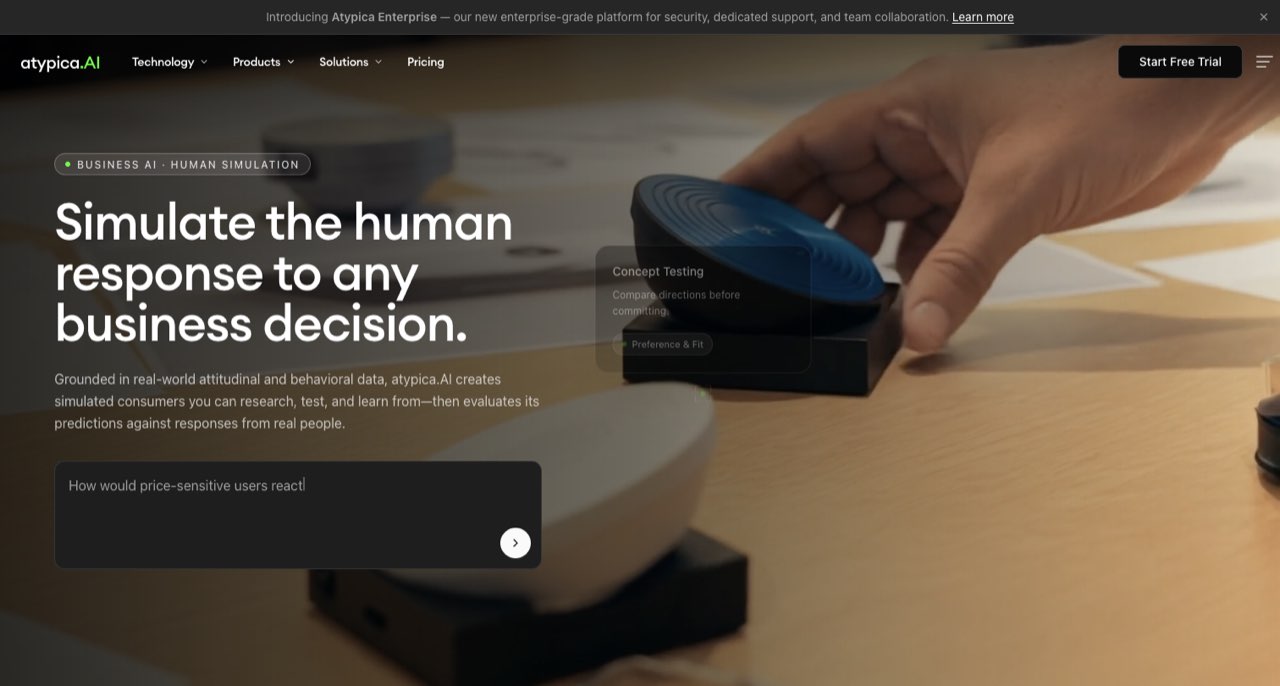
atypica.AI describes a platform for research, personas and interviews, with simulations informed by behavioral and attitudinal data. A useful role for a creator is exploring questions and competing explanations before running a real audience experiment. A simulated preference should remain a hypothesis until you have appropriate real-world evidence for the decision.
A creator can spend weeks polishing an offer for an audience that never wanted it. Audience research is meant to reduce that uncertainty, but a small business rarely has unlimited time for interviews, surveys and analysis. atypica.AI offers an AI-assisted route through research and simulated human responses. Its value depends on remembering what kind of evidence you are looking at.
atypica.AI describes a platform for research, personas and interviews, with simulations informed by behavioral and attitudinal data. A useful role for a creator is exploring questions and competing explanations before running a real audience experiment. A simulated preference should remain a hypothesis until you have appropriate real-world evidence for the decision. [1] [4]
Give the study a decision it can actually change
“Research my audience” is too broad to guide a useful next step. A better brief might be: “I teach freelance video editors. Should the next lesson explain finding clients, organizing revisions or charging for extra deliverables?” That question names an audience, three alternatives and an editorial decision.
Write down what you already know separately from what you suspect. Real viewer comments belong in the first group when they have actually been observed. Your interpretation of why viewers commented belongs in the second. This prevents a research tool from being asked to confirm an assumption that was silently presented as a fact.
Also identify what would change your mind. If every possible answer leads to the same product launch, the exercise may be producing reassurance rather than research. A useful study should make it possible to choose a different topic, reframe the offer or decide that the question is still unresolved.
Personas are a way to explore a model of an audience
The vendor's technology page describes AI personas with maintained characteristics and the ability to build a private persona library from interview data. Its creator page markets research for content direction and trends. These are vendor descriptions of the system; we have not independently validated its population coverage, prediction accuracy or fit for a specific creator niche. [4] [5]
Use a persona discussion to surface possible objections. A beginner might worry that a course assumes expensive software. An experienced freelancer might question whether the material goes beyond familiar advice. Those are useful questions to investigate with real people, even when the simulated conversation itself is not evidence that customers hold those views.
Watch for audience definitions that are too generous. “English-speaking creators” contains people with very different jobs, budgets, equipment and reasons to learn. A more specific segment gives you a better chance of understanding a disagreement and designing a sensible follow-up.
The token budget changes how you should design the work
The current pricing page lists Pro at US$20 per month with two million tokens, Max at US$50 with five million, and Growth at US$249 with three seats and 25 million shared tokens. It describes a typical study as approximately 400,000 tokens, with complex work requiring more. Bonus allowances can be promotional, so the base allowance is the safer planning figure. [2]
| Plan | Base monthly price | Base token allowance |
|---|---|---|
| Pro | US$20 | 2 million |
| Max | US$50 | 5 million |
| Growth | US$249 | 25 million shared; three seats listed |
Dividing two million by 400,000 gives five studies as a simple planning illustration. It is not an entitlement to five completed reports. Follow-up questions, persona work and a more complicated study can alter usage. The relevant number is the cost of answering your decision well enough to act, rather than the number of reports a marketing comparison can fit into a table.
Set a stopping rule before starting. For the lesson-topic example, you might need three objections for each option, a clear statement of uncertainty and a proposed real-world test. Additional simulated dialogue has diminishing value if it does not change that next step.
Recent updates worth checking
The official changelog includes an October 21, 2026 update about earning tokens and a September release describing clearer token-usage breakdowns and Growth plans. It also records report-export and research-workflow changes. These dated updates establish product activity; they do not establish better decision accuracy for your audience. [3]
Usage visibility is particularly relevant to a solo creator. A balance alone does not tell you whether the expensive part was the initial analysis, an extra report or repeated exploration of an unclear question. Keep the study brief and the usage record together so the next research task starts from what you learned.
Turn the output into a real audience test
Suppose a study suggests that revision management is the strongest course topic. A useful next step is a small piece of content that addresses the proposed problem: perhaps a sample revision checklist with an invitation to explain the hardest part of client feedback.
Decide in advance which response matters. A high view count may tell you the opening attracted attention. It does not necessarily show that viewers want to pay for the course. Depending on the decision, a detailed reply, an actual signup or a request for a specific resource may be more relevant evidence.
Keep alternative explanations in view. A weak response might mean the topic is unimportant, the audience was wrong, or the presentation failed to make the benefit clear. The research becomes more useful when it helps you distinguish those possibilities rather than supplying a confident story after any outcome.
Write the evidence trail before writing the conclusion
A small research log can have four columns: source, observation, interpretation and next test. Place a real comment in observation. Place the AI's proposed explanation in interpretation. Put the next content experiment in the final column.
This makes the resulting brief easier to share with an editor or collaborator. They can see which statements came from actual viewers, which came from your reasoning and which are generated possibilities. It also makes corrections straightforward when new evidence challenges the initial interpretation.
Handle uploaded interviews with the same care as any hosted AI research service. Remove unnecessary identifiers and confirm the applicable data arrangements before using private participant or client material. A convenient persona-building workflow is not, by itself, permission to repurpose someone else's interview.
When atypica.AI makes sense
atypica.AI is worth evaluating when you have a specific audience decision, enough context to define it and a way to test the resulting hypotheses. It is a weaker fit when the real need is simply to organize a few existing comments or summarize one interview.
Our editorial preference would be a bounded study followed by an observable experiment. That keeps the tool in a useful role: helping you ask better questions before committing scarce production time. For organizing source material first, see our Gemini Notebook guide; for capturing your own thinking, the Loqui article covers a different part of the workflow.
For dictating text for a creator workflow, read our Loqui guide. ↗
For working through a collection of research sources, read our Gemini Notebook guide. ↗
How we assessed this tool
Official product, documentation and policy research; no account-based or paid-output benchmark.
Questions & answers
Does synthetic audience feedback establish real demand?
It can help form a hypothesis, but it does not by itself show what your actual audience will do. Follow a consequential decision with an appropriate real-world test.
How do I avoid an endless AI research study?
Name the decision, alternatives and stopping rule before starting. Stop when you have enough information to design the next meaningful experiment.
What evidence should stay separate in a creator brief?
Keep real observations, generated possibilities, your interpretation and the next test in distinct fields. This makes the reasoning easier to question and update.
Sources & check dates
- 1. atypica.AI product overview ↗ · Checked 2026-10-26
- 2. Current pricing and token allowances ↗ · Checked 2026-10-26
- 3. Official product changelog ↗ · Checked 2026-10-26
- 4. Technology and persona methodology (vendor claims) ↗ · Checked 2026-10-26
- 5. Creator use cases ↗ · Checked 2026-10-26
Related reading & tools
 article
Gemini Notebook Review for Creators Who Need Better Research
Explore Gemini Notebook, formerly NotebookLM, for source-based scripts and explainers. Learn its strengths, privacy conditions and research limitations.
Read more ↗ article
Loqui Review: Pricing, Free Limits and Offline Privacy
Loqui dictation for Mac and Windows: the weekly free quota, $8/$16 plans, meeting allowances and what its privacy policy actually says.
Read more ↗