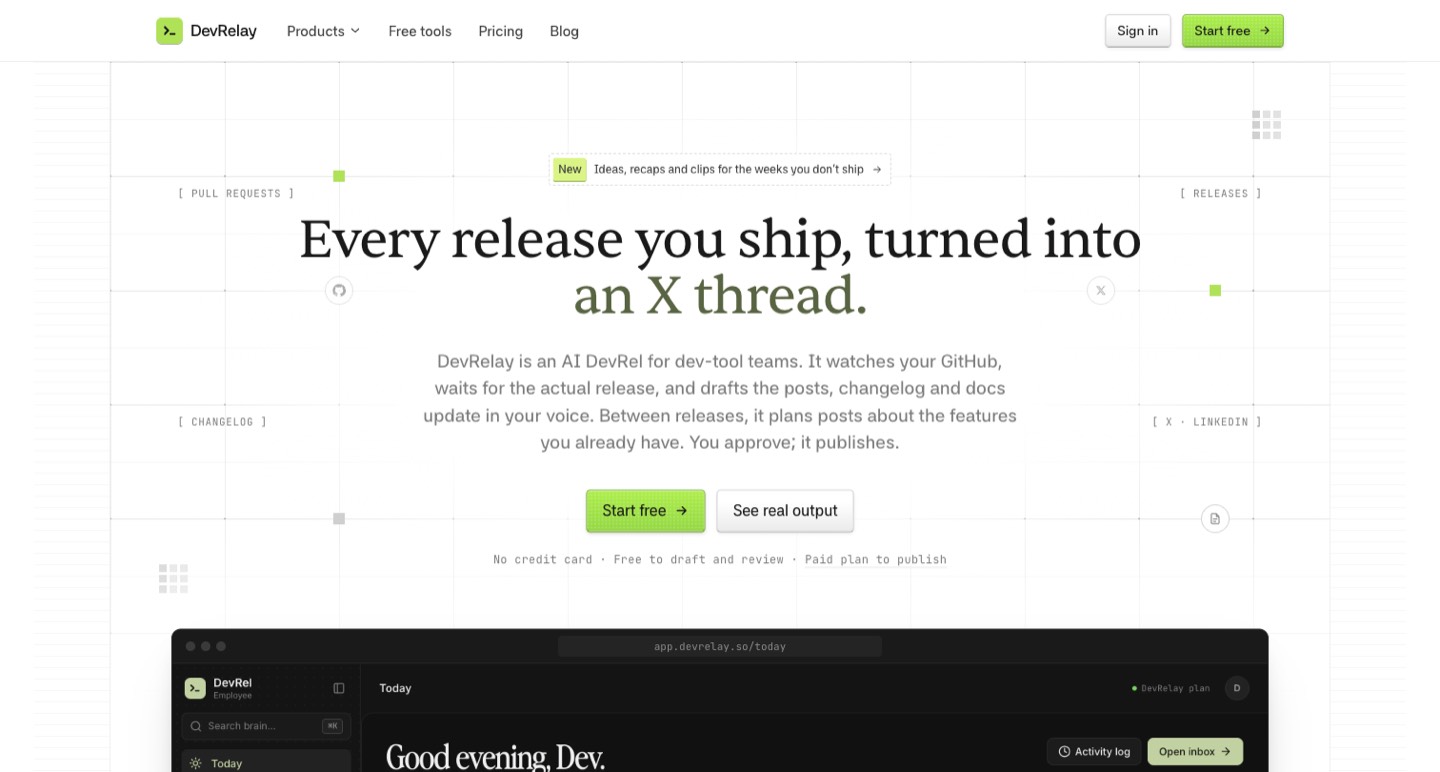
DevRelay turns connected GitHub releases and product sources into drafts for launch posts, changelogs, documentation and related channels. Its important distinction is the review workflow: draft claims are tied to evidence and publication requires approval. Free access lets a team inspect drafts; the advertised publishing plan is $999 a month per organization. We researched the public service and policies without connecting a repository.
A software creator can ship several useful improvements while the public product story stays unchanged. The release notes are technical, the website still describes an older limitation and a social post announces a feature that is only available in beta. Coordinating the communication becomes a recurring editorial job.
DevRelay turns connected GitHub releases and product sources into drafts for launch posts, changelogs, documentation and related channels. Its important distinction is the review workflow: draft claims are tied to evidence and publication requires approval. Free access lets a team inspect drafts; the advertised publishing plan is $999 a month per organization. We researched the public service and policies without connecting a repository. [1] [2]
Merged code is not automatically a released feature
A merged change can sit behind a feature flag, depend on an unfinished migration or be available to a small beta group. A useful announcement must describe what the intended audience can actually do today.
DevRelay advertises monitoring a repository, collecting release evidence and holding merged work until it meets the release gate. The public workflow also describes checking feature names, numbers and unsupported claims. These are vendor-described controls; we have not independently measured how often they catch an error. [1]
Before evaluating any release-writing tool, choose an example with a real availability distinction. Prepare the expected answer: which users receive the change, what plan it needs and what remains in preview. A draft that sounds polished while missing that boundary is not ready to publish.
Give the tool an accurate product vocabulary
The supporting website, documentation and changelog help explain the code to a reader. If those sources use inconsistent names, a writer can reproduce the inconsistency. Make a small canonical list of feature names, audience terms, plan restrictions and phrases you do not use.
For a first evaluation, connect the smallest appropriate repository and a carefully selected set of sources. The pricing page says GitHub repositories do not count toward the free tier's three knowledge-source limit; the limit concerns sources such as a website or docs URL. Confirm the actual permissions and scope before authorizing access. [2]
Review the first draft against the diff and the released behavior. Mark an incorrect claim with the evidence that fixes it, rather than simply rewriting the sentence. This helps you see whether later drafts preserve a correction or merely imitate the new phrasing.
The free tier is a drafting evaluation
The public plan comparison distinguishes draft-and-review work from things leaving DevRelay. Posting, scheduling, hosted changelog publication, docs pull requests and Markdown export are described as paid capabilities. A free generated draft should not be treated as a promise of free multichannel publishing or export. [2]
| Decision | What the public offer establishes | What to inspect |
|---|---|---|
| Try the writing | Free drafting and review | Accuracy on a released change you understand. |
| Automate publication | Paid organization workflow | Exact-version approval and connected destinations. |
| Update documentation | Proposed changes through pull requests | Diff quality, reviewer and merge responsibility. |
| Create launch videos | Paid package can include work by the vendor's team | Inputs, turnaround and approval scope. |
The distinction matters to a small maker. A tool can be useful for examining draft quality while its paid publishing package remains too large for the current volume of work.
Put the $999 fee against a real workload
The reviewed price is monthly, per organization. At eight release cycles a month, $999 divided by eight is about $124.88 per cycle before the team's review time. That calculation does not establish value or savings; it gives you a concrete number to compare with your current process. [2]
If you value the relevant work at $50 an hour, the subscription alone is equivalent to 19.98 hours each month. Measure how much preparation, drafting, checking and distribution work would actually change. Keep review time, setup and corrections in the calculation.
A team with frequent releases, several channels and a documentation backlog may have a different case from a solo maker publishing one update. The decision should follow the work you can identify, not an assumed number of hours saved by AI.
Approval must match what goes out
The service describes approval binding to the exact draft version. Review an update after any meaningful change, including an attached image or a revised availability statement. An approval recorded before the copy changed is not an adequate review of the final post.
For documentation, the official workflow opens a pull request rather than directly merging a change. Read the proposed diff as you would any other documentation contribution. Check links, examples and whether the new text explains the released behavior for the right reader. [5]
The plan also includes certain content that the team finishes or posts itself. The public offer says replies and some community drafts are not automatically posted by DevRelay. Map each channel's final action rather than assuming a single approval means every destination is handled the same way. [2]
Private repository access is a separate decision
The privacy policy describes processing connected repository material and product sources through AI and infrastructure providers. It says content is not used to train AI models and describes deletion after an account or organization request, with exceptions for required records. Those published commitments still involve processing the connected material. [3]
The paid creative offering can also involve vendor staff working on a launch video from supplied code or material under the described arrangement. Establish the intended scope before enabling that service for a private project. Do not assume that every part of a package marketed with AI runs without people. [3]
Read the security information, select appropriate repository permissions and identify who in your team can approve destinations. We have not installed the GitHub application, audited its controls or tested a production release. [6]
A useful first release audit
Choose one recent release and list five statements a public announcement might make. For each statement, record the supporting change and any plan or availability restriction. Compare the drafts with that list.
Then review the same update in two forms: a short post for an existing user and a changelog entry for someone deciding whether to upgrade. The vocabulary and detail should differ while the facts stay consistent. Reject invented customer outcomes and broad performance claims unsupported by the release.
For a source-organizing workflow before drafting, read our Kuse research-brief review. ↗
DevRelay is most interesting for a software creator team whose communication process has become a bottleneck. Use free drafting to inspect evidence and voice, then evaluate the paid workflow against a measured workload and a clear human approval process.
How we assessed this tool
Official public product, pricing, documentation and policy research with AI-assisted original editorial analysis. No installation, paid output benchmark or performance rating.
Questions & answers
Can DevRelay publish GitHub release announcements for free?
The reviewed free tier is for drafting and review. Posting, scheduling, hosted changelog publication, docs pull requests and Markdown export are described as paid capabilities. The public publishing plan is $999 per month per organization.
Does DevRelay merge documentation changes automatically?
The public workflow describes opening documentation pull requests for review. It does not claim to merge them for you. Inspect the proposed change and keep a clear human review/merge responsibility.
Do DevRelay's evidence checks guarantee that a draft is correct?
No independent guarantee is established by this review. The vendor describes release and claim-evidence gates, but the team should still check feature availability, numbers, plan restrictions and the exact approved version before publication.
Sources & check dates
- 1. Official release-to-content workflow ↗ · Checked 2026-10-27
- 2. Free versus paid boundaries and current price ↗ · Checked 2026-10-27
- 3. Repository content, AI providers and retention ↗ · Checked 2026-10-27
- 4. Service, approvals and billing terms ↗ · Checked 2026-10-27
- 5. Documentation pull-request workflow ↗ · Checked 2026-10-27
- 6. Security and permissions information ↗ · Checked 2026-10-27
Related reading & tools
toolDevRelay
Draft release announcements and docs from GitHub evidence, with approval.
Read more ↗ article
Kuse Review: Turn Scattered Research into a Creator Brief
Use Kuse to organize source files and draft creator briefs. Understand credit billing, document permissions, privacy and source-checking limits.
Read more ↗ article
atypica.AI Review: AI Audience Research Before You Launch
Evaluate atypica.AI for content and offer research. Understand synthetic personas, token budgets, recent updates and validation with real viewers.
Read more ↗