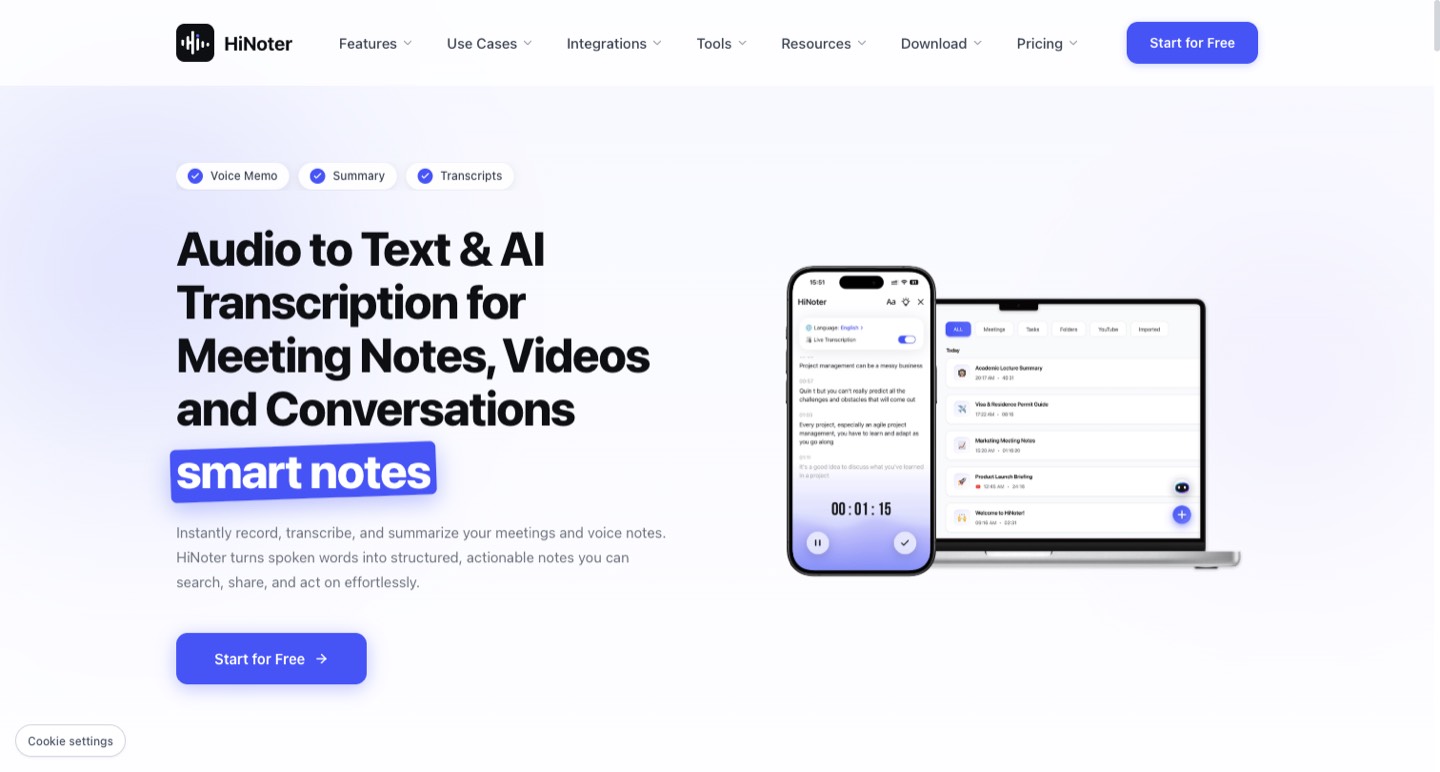
HiNoter combines transcription, summaries and searchable notes for recordings, meetings and other source material. Its creator use case is a reviewable research brief. The free access is a one-time limited allowance, and the weekly and yearly subscriptions have very different long-term costs. We researched public features, live pricing, privacy and terms without purchasing a plan or testing transcription accuracy.
A creator interview usually contains more than one usable story. There may be a strong explanation, a surprising qualification and a phrase worth quoting exactly. A transcript makes that material searchable, but the next step is deciding which statements belong in the piece and which still need verification.
HiNoter combines transcription, summaries and searchable notes for recordings, meetings and other source material. Its creator use case is a reviewable research brief. The free access is a one-time limited allowance, and the weekly and yearly subscriptions have very different long-term costs. We researched public features, live pricing, privacy and terms without purchasing a plan or testing transcription accuracy. [1] [2]
Build the brief around questions and source moments
Suppose you interview a lighting specialist for a beginner tutorial. The useful output is not simply a shorter transcript. You need an explanation of one lighting decision, a practical example, an exception and the source moment supporting each of them.
Prepare a note structure before importing the recording: proposed claim, supporting passage, time or location in the source, qualification and follow-up question. This helps prevent an automatic summary from becoming the only version of the interview anyone reads.
The official site describes recording or uploading audio, transcription, summaries, chat and search across notes, with meeting and document-related workflows. Use those capabilities to recover material you can inspect. A fluent summary remains a draft until it has been checked against the recording. [1]
The free allowance is not a recurring weekly quota
The pricing comparison marks free note creation as one time, with limited chat and summaries. Its FAQ says a user who has consumed the one-time free credit needs Pro to continue transcribing new meetings. That is different from a fresh allowance arriving every week. [2]
Choose the first sample deliberately. Use a recording you are permitted to process, with reasonably clear audio and a known passage to compare. A short, representative interview is more informative than using the allowance on a long file whose correct transcript nobody has time to check.
Record what the free access actually lets you complete: transcript, summary, retrieval of a particular answer and a usable export or handoff. Do not assume that seeing a feature name establishes the exact allowance or long-session limit for every account.
Compare billing periods using the real amount charged
The live public page lists Personal Pro at $6.99 per week or $69.99 per year. The yearly option also shows a mathematical weekly equivalent; that smaller number is not a weekly invoice. Team billing is separate and starts from two paid seats. [2]
| Illustrative personal usage period | Weekly option | Yearly option |
|---|---|---|
| Four weekly renewals | $27.96 | $69.99 annual payment |
| Fifty-two weekly renewals | $363.48 | $69.99 annual payment |
The arithmetic assumes the observed prices remain unchanged and excludes applicable taxes or store differences. It illustrates why a small weekly charge deserves a yearly comparison. For an isolated research sprint, flexibility may be useful. For recurring interviews, compare the ongoing commitment before letting a weekly subscription renew by habit.
The terms describe periodic subscriptions renewing until cancelled. Review the actual purchase channel and its cancellation route, particularly if you subscribe through a mobile store rather than the website. We did not test checkout or cancellation. [4]
Transcription quality and editorial accuracy are separate
A transcript can get every word mostly right and still leave an editor with work. Speaker identity, a technical name, a number or a qualification may determine whether the passage can be quoted. A summary can also turn a tentative suggestion into a confident recommendation.
Check a passage where the guest changes their mind or describes an exception. Ask the note system a question that depends on that distinction, then compare the answer with the audio. Keep the original wording when a direct quote matters, and mark a paraphrase as a paraphrase in your working document.
For multilingual material, evaluate the language and vocabulary you actually use. Marketing language counts are less useful than whether the system preserves a brand name, a local place and the guest's intended meaning. We do not assign HiNoter an accuracy score from public documentation.
Cloud processing belongs in the privacy decision
The privacy policy describes selected audio, transcription text, prompts and notes reaching Microsoft Azure/OpenAI services for requested AI functionality. It also lists cloud storage and other service providers. Broad homepage encryption wording should not be read as a promise that requested AI work never leaves the device. [3]
Separate three questions: permission to record a conversation, permission to process it in the selected service and permission to publish a quotation or extract. A guest's willingness to speak does not tell you how a client's confidential information may be handled. Resolve those boundaries before uploading an unpublished interview.
The policy describes an account-deletion process with removal or anonymization after seven days, subject to its wider retention terms. Keep a source copy and approved deliverables outside the account. Deleting an account is not a substitute for understanding where connected services have already received material. [3]
A reviewable interview-to-article workflow
Start with an agreed interview purpose and a short list of questions. Keep the recording organized under a project name. After transcription, correct the most important names and numbers before asking for a summary; that reduces the chance of a mistake being repeated through later drafts.
Ask for candidate themes with supporting passages. Select one theme, then build a brief containing what the guest said, what you have independently checked and what is still uncertain. Add follow-up questions rather than letting a summary fill the gaps. Keep a correction note when a name or qualification changes, so the same mistake does not return in a later draft.
Draft the article from that brief and return to the original recording when checking quotations. A note tool can help you find the passage again, but the final factual and editorial decisions remain with the creator. Keep the distinction between a guest's experience and a claim about what every viewer should expect.
Choose the appropriate recording and research stages
For the source-recording stage of a remote interview, read our Riverside creator review. ↗
HiNoter merits a focused evaluation when repeated interviews or recordings are difficult to search and turn into an organized brief. Use the one-time allowance carefully, choose the billing period consciously and judge the quality of a checked brief rather than the speed of an unreviewed summary.
How we assessed this tool
Official public product, pricing, documentation and policy research with AI-assisted original editorial analysis. No installation, paid output benchmark or performance rating.
Questions & answers
Does HiNoter give me a fresh free transcription allowance every week?
The reviewed pricing describes one-time limited free access. After the one-time free credit is used, its FAQ says a Pro upgrade is needed to continue transcribing new meetings. We do not describe it as a recurring free quota.
What does $6.99 weekly billing cost over a year?
At an unchanged $6.99 price, fifty-two weekly renewals total $363.48 before applicable taxes or store differences. The reviewed yearly option is $69.99 charged annually; its displayed weekly average is not a weekly payment schedule.
Can I treat a HiNoter summary as a verified interview quotation?
No. Check the original recording, speaker, wording, numbers and qualifications. Use the transcript and summary to locate evidence, then retain the source moment supporting the quotation or paraphrase in your writing brief.
Sources & check dates
- 1. Official transcription and note workflows ↗ · Checked 2026-10-27
- 2. Current billing periods and free limit ↗ · Checked 2026-10-27
- 3. AI processing, storage and deletion policy ↗ · Checked 2026-10-27
- 4. Subscriptions and service terms ↗ · Checked 2026-10-27
Related reading & tools
toolHiNoter
Turn interviews and recordings into searchable transcripts and research notes.
Read more ↗ article
Riverside Review for Creators Recording Remote Interviews
Understand Riverside's local recording workflow, separate tracks and editing features, plus the upload checks and plan limits to consider before an interview.
Read more ↗ article
Gemini Notebook Review for Creators Who Need Better Research
Explore Gemini Notebook, formerly NotebookLM, for source-based scripts and explainers. Learn its strengths, privacy conditions and research limitations.
Read more ↗