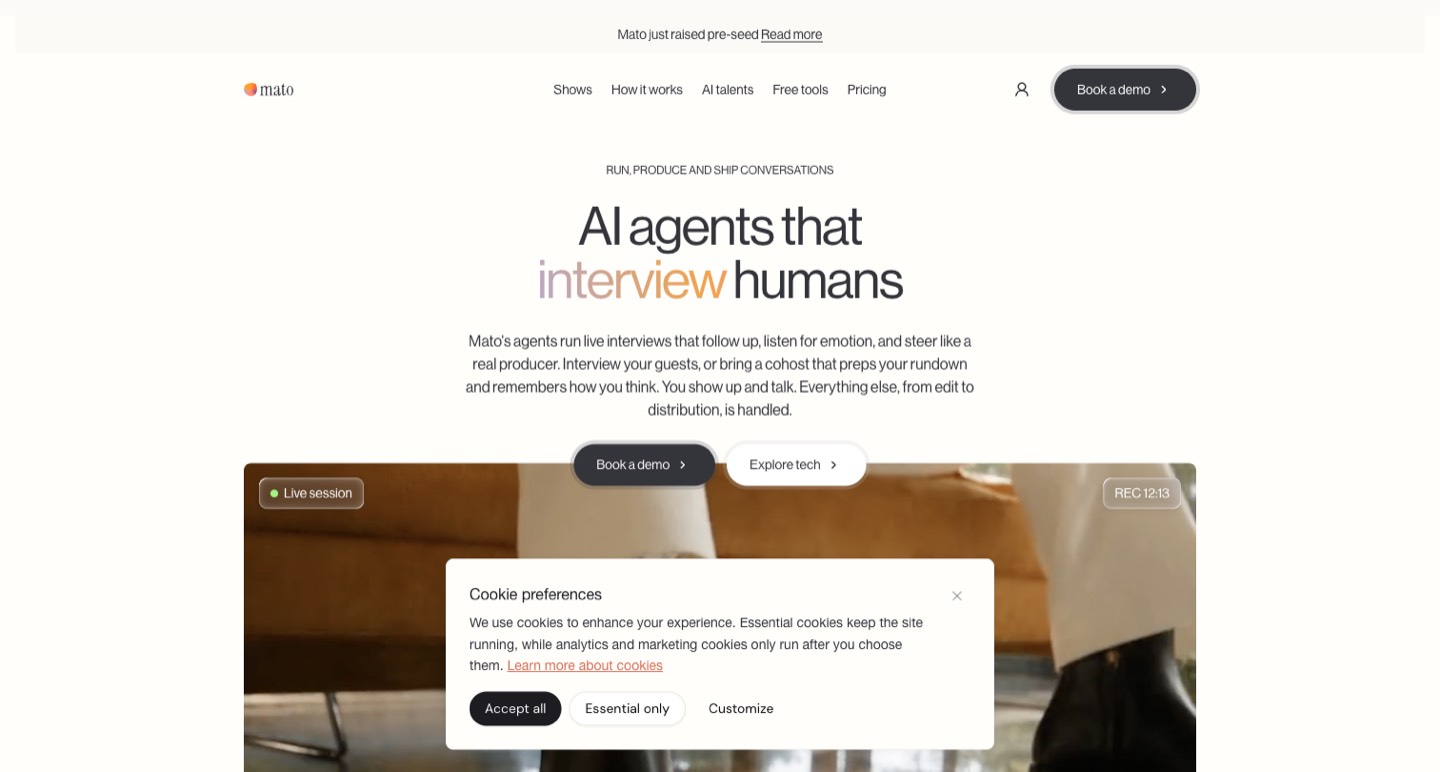
Mato advertises AI hosts that interview real guests and a wider podcast-production workflow. It is a premium business-podcast proposition. The published Launch and Business plans have substantial monthly base fees plus a fee for each published episode, and the cheaper mode should not be confused with the live-interview offering. We researched public sources without booking a demo, cloning a voice or recording an episode.
An interview podcast depends on the question after the first answer. A guest may offer a general lesson, then reveal a much more useful example when the host asks what happened on a particular day. Producing that kind of conversation also involves scheduling, editing, notes, clips and distribution.
Mato advertises AI hosts that interview real guests and a wider podcast-production workflow. It is a premium business-podcast proposition. The published Launch and Business plans have substantial monthly base fees plus a fee for each published episode, and the cheaper mode should not be confused with the live-interview offering. We researched public sources without booking a demo, cloning a voice or recording an episode. [1] [2]
Decide which kind of episode you want
A generated discussion based on source material, a topic-led episode and a live interview with a real guest have different editorial requirements. For the live interview, the guest's answers should drive the follow-up questions. For a source-led discussion, accuracy depends heavily on the source selection and script review.
Mato's pricing describes Launch around AI discussions and topic episodes, while Business includes live AI interviews with real guests and a broader production/distribution package. A buyer should confirm the content mode before comparing the headline monthly prices. [2]
Write a short show brief: audience, subject, desired depth, episode length, guest role and what the audience should learn. A service can produce polished audio without solving an unclear editorial proposition. The brief is also what you need to evaluate a demonstration meaningfully.
The episode fee is added to the base plan
The reviewed public pricing lists Launch at $1,200 a month and Business at $3,500 a month, both with an additional $50 per published episode. It also describes plan-specific clip allowances and a custom network offering. These are current public figures, not a negotiated quote or an assurance that every production request is included. [2]
| Illustrative schedule | Launch base plus episode fee | Business base plus episode fee |
|---|---|---|
| Four published episodes | $1,200 + $200 = $1,400 | $3,500 + $200 = $3,700 |
| Eight published episodes | $1,200 + $400 = $1,600 | $3,500 + $400 = $3,900 |
The examples assume the published fee applies as shown and exclude additional applicable charges and taxes. The Launch column is not a cheaper quote for a Business live-interview workflow. Confirm the included mode, revisions, deliverables and capacity before building a production calendar around either figure.
This budget makes Mato a very different purchase from an inexpensive recording or editing subscription. It deserves consideration when an established creator business has a show strategy and enough production work to evaluate the package as a whole. A beginner experimenting with a first podcast has a much smaller job to solve.
Evaluate the follow-up, not only the host's voice
For a useful demo, bring an interview subject where you know the material. Give the guest a question with an ambiguous first answer. Observe whether the next question clarifies the important point, introduces a wrong assumption or simply moves to the next prepared topic.
Also test a correction. A guest might say they joined a company in one year and then correct themselves. The final transcript, notes and clips should preserve the corrected fact. A confident synthetic delivery can make an error harder for a listener to notice, increasing the importance of the editorial review.
Mato's public description assigns roles to preparation, conversation, production and editing, and its how-it-works page outlines planning through measurement. We have not verified those behaviors in an actual session. [1] [3]
Agree on the guest's control and the final edit
A live conversation should have a clear introduction explaining the AI host and the intended recording. Decide in advance who can pause, stop, correct a statement and approve the final episode. Discuss the reuse of clips, transcript passages and promotional material as part of the project brief.
These are practical production questions rather than a claim that a particular workflow satisfies every recording rule or client policy. The service terms describe content responsibilities and include conditions around subscriptions and produced episodes. Read the current terms for the arrangement you are considering. [5]
Keep a checklist of the final deliverables: approved audio or video, transcript, show notes, episode image, clips and distribution destinations. Ask what remains editable after delivery and which originals you can retain. A package that reduces coordination is more valuable when its handoff is explicit.
Reuse should preserve the meaning of the interview
A strong clip may need the question that preceded it. If a guest is discussing one unusual customer, a shortened excerpt should not make that answer sound like a statement about every customer. Review the clip in context before placing it in an ad or a sales page.
For show notes, separate the guest's experience from independent factual support. Link the sources you actually checked. An automatically generated FAQ is a useful draft only if its questions and answers faithfully reflect the approved conversation.
Measure distribution using an outcome you can observe: completed listens from the intended audience, useful guest referrals or qualified follow-up conversations. Mato's public audience, growth and pipeline claims are vendor claims. We do not convert its marketing calculator into a Picktool savings benchmark.
Understand what connected services can see
The privacy policy describes processing interview and account content to provide the service, with infrastructure and other providers involved. It separately describes connected-assistant access and says those assistant connections cannot publish, schedule, delete or change billing. That limited connection scope should not be generalized to every control in the main production platform. [4]
Before using a private customer interview, establish what information may be uploaded, which people will review it and how long the source material and derivatives remain available. Keep the final approved masters in storage your business controls.
A recording can contain information a guest did not intend to publish. Build a review point before distribution rather than assuming an automated production stage recognizes every off-record remark, uncertainty or contractual restriction.
Use a pilot to test the whole production loop
A meaningful pilot should begin with the brief and end with the deliverables you would actually publish. Record time spent preparing, reviewing, correcting and coordinating. Note where a person still needs to make a decision, and whether the service makes that decision easier to evaluate.
Compare the experience with the workflow you would otherwise use. Include your own recording, editing and distribution effort, not a generic agency benchmark. Keep the difference in editorial control visible alongside any difference in time or cost.
For a creator-controlled remote recording stage, read our Riverside review. ↗
For repurposing a long recording into short clips with explicit usage math, see our Cliphi review. ↗
Mato is a conditional shortlist for a business that wants a sustained podcast operation and can justify the production budget. Confirm the interview mode, full spending model and guest-review process first. A convincing voice is a small part of the decision; the quality of the approved conversation and its handoff matters more.
How we assessed this tool
Official public product, pricing, documentation and policy research with AI-assisted original editorial analysis. No installation, paid output benchmark or performance rating.
Questions & answers
Does Mato cost only $50 per podcast episode?
No. The reviewed plans add the published-episode fee to a monthly base. Four episodes at the listed prices imply $1,400 for Launch or $3,700 for Business before additional applicable charges and taxes; those modes have different scope.
Does the cheapest Mato plan include live interviews with real guests?
The reviewed pricing places AI discussions and topic episodes in Launch and advertises live AI interviews with real guests in Business. Confirm the required content mode and deliverables rather than assuming the lower base covers every workflow.
Will an AI podcast host guarantee audience growth or business leads?
No. This review does not independently validate Mato's audience, pipeline, speed or savings claims. Evaluate a pilot against your own editorial goals, guest experience, approved deliverables, workload and observable audience response.
Sources & check dates
- 1. Official AI interview and host description ↗ · Checked 2026-10-27
- 2. Current plans, modes and published-episode fee ↗ · Checked 2026-10-27
- 3. Production stages and demo description ↗ · Checked 2026-10-27
- 4. Recording/content privacy and assistant scope ↗ · Checked 2026-10-27
- 5. Subscription, content and billing terms ↗ · Checked 2026-10-27
Related reading & tools
toolMato
AI-led podcast conversations and plan-dependent production for businesses.
Read more ↗ article
Riverside Review for Creators Recording Remote Interviews
Understand Riverside's local recording workflow, separate tracks and editing features, plus the upload checks and plan limits to consider before an interview.
Read more ↗ article
Cliphi Review: Turn Podcasts into Short Clips and Estimate Costs
Understand Cliphi's input-minute and rendering charges, credit rollover, 30-day storage and a practical podcast-to-Shorts workflow.
Read more ↗