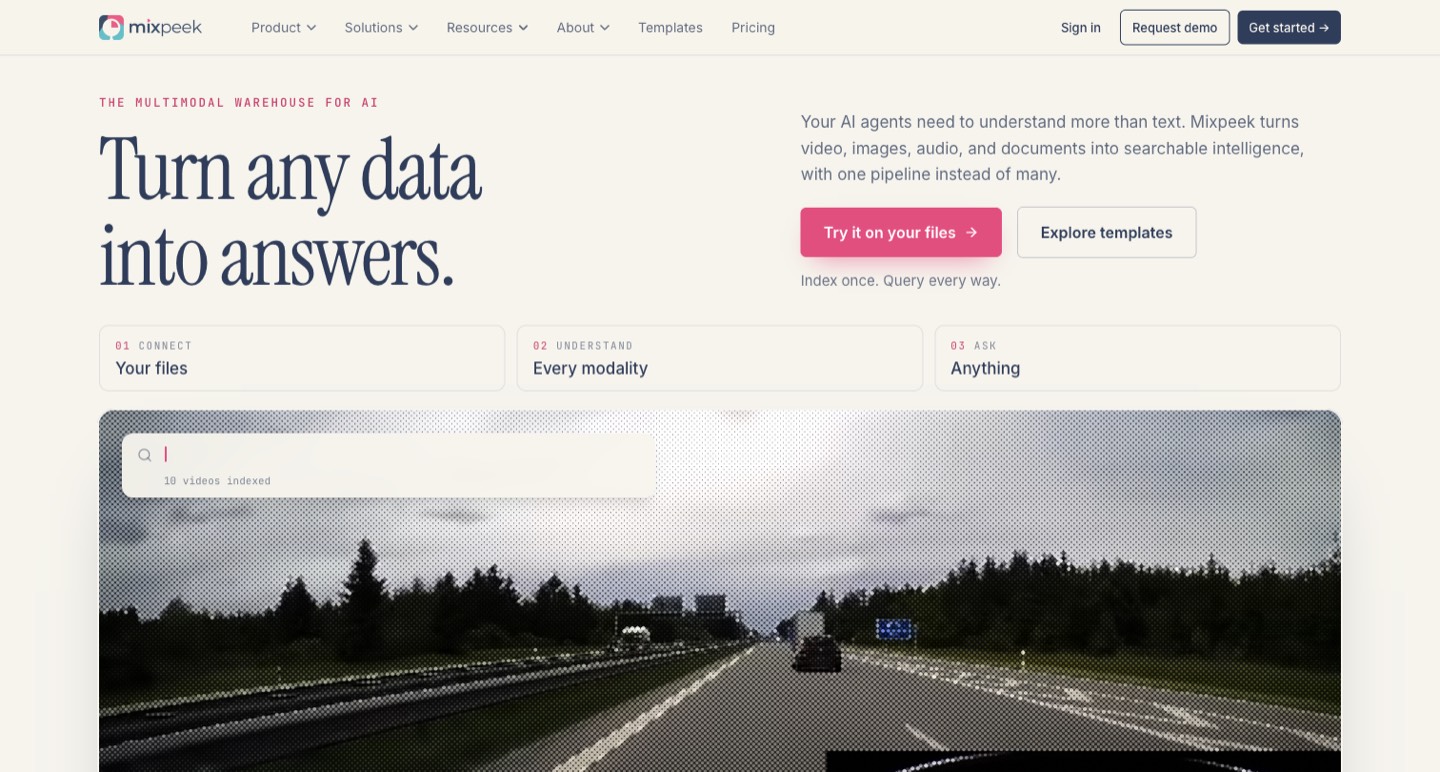
Mixpeek analyzes video, images, audio and documents so applications can search their contents. Its creator use case is an organized, queryable media archive. It requires a configured ingestion and retrieval workflow, making it more relevant to media teams and technically supported creators than someone seeking an instant video editor. No paid indexing, API call or private-file upload was performed for this review.
The expensive part of a media archive is often finding the right moment again. You remember a customer explaining a particular problem, but the filename only identifies the interview date. Another useful shot contains no spoken words at all. A transcript search and a folder hierarchy answer only part of the retrieval problem.
Mixpeek analyzes video, images, audio and documents so applications can search their contents. Its creator use case is an organized, queryable media archive. It requires a configured ingestion and retrieval workflow, making it more relevant to media teams and technically supported creators than someone seeking an instant video editor. No paid indexing, API call or private-file upload was performed for this review. [1] [3]
Describe the moment you want to recover
A helpful archive query might be “a close-up of the blue notebook while the presenter explains the binding.” That combines visible content and speech. A useful result should identify a source file and a relevant segment so an editor can inspect the surrounding material.
Build a small set of real questions before configuring search. Include one spoken phrase, one visible action, one piece of text on screen and one combination of those. Add a query whose correct answer is that no suitable clip exists. An archive tool should make that uncertainty visible rather than encourage an editor to trust an attractive but irrelevant match.
The official platform describes extraction of scenes, transcripts, visual features and document information, followed by search across modalities. Its example performance figures illustrate the vendor's product; they are not results from Picktool's archive. [1]
Choose the managed-file or vector route deliberately
Mixpeek's pricing distinguishes sending raw files for managed indexing from bringing vectors to its vector-store product. Managed processing performs work on media. A vector store starts from representations you already have. Those are different starting points and cost models. [2]
| Starting point | Work you still need to understand | Creator implication |
|---|---|---|
| Raw recordings and images | Ingestion, extraction, indexing and retrieval | Useful when the archive has not already been made searchable. |
| Existing embeddings or vectors | Storage, search and the upstream pipeline that produced them | Usually requires technical ownership of the media-processing stack. |
| Specific infrastructure requirements | Deployment, model and operational responsibilities | Get a deployment-specific scope before planning around a public entry price. |
The documentation provides SDK, API and integration paths. A creator should identify who will configure the source bucket, maintain permissions and investigate failed ingestion. A working demo on a few files is valuable, but it does not remove those ongoing responsibilities. [3]
Estimate the ingestion bill before the archive grows
The reviewed managed entry plan is $25 a month plus usage, with $10 of processing included. The pricing FAQ quotes video processing at $0.05 a minute and audio at $0.01 a minute, identifying those usage rates as of August 2026. We re-read the page for this review; checkout and a production invoice were not tested. [2]
For a hypothetical twenty-hour video archive, 1,200 minutes at the published video rate would be $60 in processing. If that rate and the $10 included allowance apply to the intended pipeline, the base-plus-processing illustration is $25 + $50 = $75, before applicable storage, query, other processing or tax charges. This is arithmetic for planning, not a quote.
Ask what triggers reprocessing. Replacing a file, changing an extraction configuration or adding another analysis stage can affect cost. Keep a representative pilot separate from the full archive until the actual metering and result quality are understood.
Storage units matter too. A price expressed per number of vectors does not directly answer what a terabyte of original video costs to retain and search. Record media volume, the derived data being stored and the retention period instead of combining unlike headline units.
Carry rights and context into the search result
A searchable clip is not automatically a reusable clip. Your archive may contain a customer interview licensed for one campaign, stock footage restricted to a client or material with an expired release. Search needs access to the relevant permission and project metadata.
For a pilot, attach a small set of practical fields: project, owner, source date, rights status and allowed use. Decide which fields should filter results and which should be visible to an editor before download. Avoid embedding personal details in an index when a project identifier will do.
Review the surrounding recording before extracting a statement. A search result can find the word “approved” while missing the sentence that made the approval conditional. Better retrieval shortens the investigation; it does not complete editorial verification.
Hosted search has a real processing boundary
The privacy policy lists cloud infrastructure and model providers that can process content for configured features. It describes hosted production processing in the United States and says customer content is not used to train foundation models. Namespace-specific interaction signals may be used to improve retrieval within that namespace. [4]
Check that architecture against the rights you have to process each archive. Keeping the original files in a bucket you control does not establish that every extracted feature or model request remains there. Where a deployment must meet a specific residency or infrastructure requirement, establish the supported arrangement directly rather than assuming it from the managed plan.
The service terms cover the platform and the content responsibilities attached to its use. We have not performed a security audit or validated a particular regulated-data deployment. [5]
Measure whether retrieval helps an editor
Use a deliberately mixed pilot: interviews, silent B-roll, a screen recording and a document. Have an editor locate the answer to each prepared query using the existing workflow, then inspect the search workflow. Record the correct segment, time spent checking and the reasons a result was rejected.
Keep failure types separate. The file may not have been ingested, the useful information may not have been extracted, the query may be ambiguous or the ranking may favor a nearby but unsuitable clip. Each calls for a different correction. A single overall accuracy percentage would hide that distinction.
Also test the negative query. A system that returns plausible material for every request can create more review work than one that admits a gap. The final measure is whether a human can confidently recover usable source material.
Where a simpler library may be enough
For a primarily local AI-image collection, see our Image MetaHub organizer and metadata review. ↗
For organizing selected research sources into a creator brief, read our Kuse workspace review. ↗
Mixpeek becomes more interesting when the archive spans several media types and repeated searches justify a maintained pipeline. Start with questions an editor actually asks, keep rights metadata close to every result and budget for the full ingestion-and-review process.
How we assessed this tool
Official public product, pricing, documentation and policy research with AI-assisted original editorial analysis. No installation, paid output benchmark or performance rating.
Questions & answers
Is Mixpeek an ordinary consumer video editor?
Its main role is media analysis, indexing and retrieval. A creator team configures an ingestion/search workflow to recover useful material; it is not presented here as an instant replacement for a timeline editor.
Is $25 a month the full cost of indexing a video archive?
No. The reviewed managed entry plan has a $25 monthly base and usage charges, with $10 of processing included. Media processing, selected pipeline steps, storage and queries can affect the total. Confirm an estimate for your own files.
Does finding footage through AI search establish that I can reuse it?
No. Retain rights, project and permission metadata and inspect it before reuse. A relevant scene or transcript match does not determine the license or the context in which a person agreed to appear.
Sources & check dates
- 1. Official multimodal media workflow ↗ · Checked 2026-10-27
- 2. Managed, vector and enterprise pricing ↗ · Checked 2026-10-27
- 3. Official product documentation ↗ · Checked 2026-10-27
- 4. Hosted processing, providers and privacy ↗ · Checked 2026-10-27
- 5. Service and content terms ↗ · Checked 2026-10-27
Related reading & tools
toolMixpeek
Search a media archive by scenes, spoken content and extracted information.
Read more ↗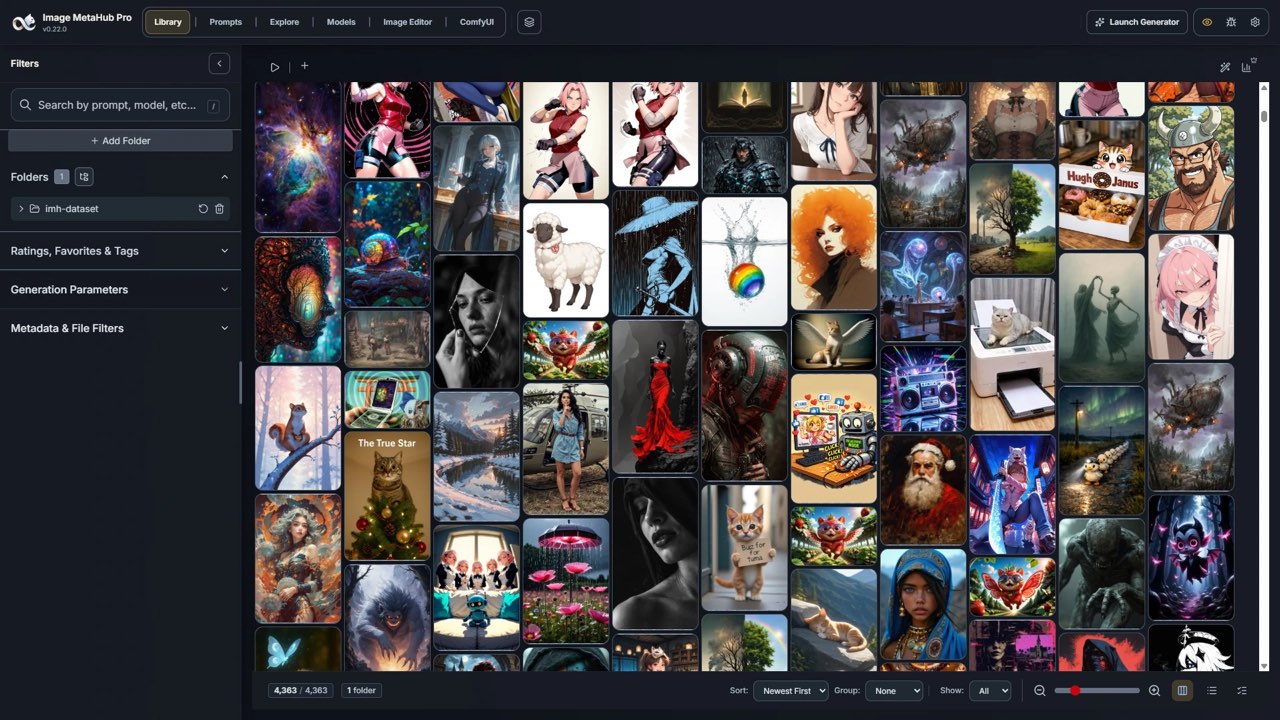 article
Image MetaHub Review: Organize AI Images and Read Their Metadata
Organize ComfyUI and Stable Diffusion outputs locally. Compare Image MetaHub Free and Pro, metadata limits, optional integrations and licensing.
Read more ↗ article
Kuse Review: Turn Scattered Research into a Creator Brief
Use Kuse to organize source files and draft creator briefs. Understand credit billing, document permissions, privacy and source-checking limits.
Read more ↗