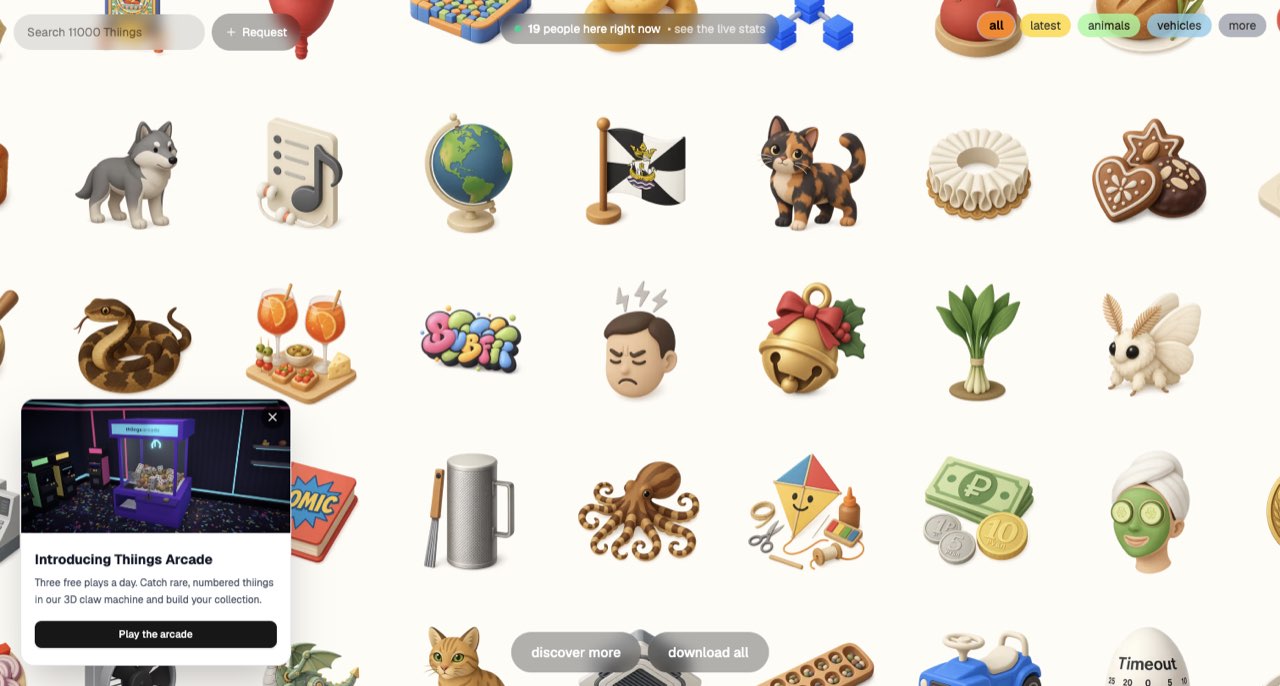
Thiings offers a large collection of AI-generated 3D icons and a separate custom-generation experience. Its soft, dimensional illustrations can be useful for creator graphics. Our research also found conflicting official usage wording: the main collection terms restrict the free license to personal, non-commercial work, while the My:Thiings subdomain describes broader free use. That conflict deserves attention before a commercial project.
A downloaded icon feels like a small design decision until it appears in a paid course, a client website or a pack of merchandise. At that point, the useful question is no longer whether the image is free to download. It is whether your intended use is covered by the applicable license.
Thiings offers a large collection of AI-generated 3D icons and a separate custom-generation experience. Its soft, dimensional illustrations can be useful for creator graphics. Our research also found conflicting official usage wording: the main collection terms restrict the free license to personal, non-commercial work, while the My:Thiings subdomain describes broader free use. That conflict deserves attention before a commercial project. [1] [2]
What Thiings is useful for
The official collection overview advertises more than 10,000 AI-generated icons and ways to download individual assets or obtain the collection. The live homepage displayed a larger collection count when visited. An exact inventory number is less useful than finding several objects that work together in the visual style your project needs. [3] [4]
A creator might use a small, consistent set to illustrate a newsletter series, explain steps in a tutorial or add visual cues to a landing page. The strongest use is usually supporting a clear message. An icon of a camera should help a reader recognize a recording step, rather than compete with the sentence explaining it.
Start by choosing the message and the space available. A glossy object that looks attractive at a large size may become difficult to read inside a small mobile card. Before collecting twenty assets, place three candidates at the actual output size and inspect their silhouettes, contrast and visual weight.
What the main collection license currently says
The main terms list Free, US$49 lifetime Indie, US$199 Business and custom Enterprise options. The relevant usage distinctions are below. [1]
| Use case | Main terms point to | Practical implication |
|---|---|---|
| Personal, non-commercial project | Free; attribution required | Keep the attribution visible. |
| Commercial business under US$200,000 annual revenue | Indie | Check both use and revenue. |
| Client work | Tier based on the end client's revenue | Record whose project is being licensed. |
| A downloadable icon library | Standalone resale restrictions | A collection purchase does not authorize a competing asset pack. |
The point of this table is to identify the decision, not to determine a legal entitlement for every business arrangement. A receipt proves a purchase occurred; it should be kept alongside the terms and the scope of the work it was purchased for.
Why older “free for commercial use” summaries can mislead
The My:Thiings terms say individual icons can be used in personal and commercial projects, with attribution appreciated rather than required. That differs materially from the current main collection terms. The main terms also describe legacy lifetime purchases made before December 2025. These are different statements on different official pages; we have not established which agreement governs a particular user's acquisition. [2] [1]
It would be easy for a directory to flatten these pages into a single free-commercial-use badge. We would avoid using that badge to approve a paid client project. Record the exact asset source, acquisition date and agreement attached to the transaction. If they do not resolve your use case, leave commercial clearance unresolved until the vendor confirms it in writing.
That approach is especially relevant when a design will be handed to another party. The client may expect to reuse the artwork in advertising, packaging and future projects. A license decision made for a personal mockup may not cover that wider handover.
Using an icon inside a design is different from distributing the icon
The main terms prohibit standalone resale and redistribution, and state that an artwork license does not grant rights in depicted third-party marks or a person's likeness. The subdomain terms also restrict resale and redistribution. A paid tier should therefore not be read as permission to include loose icons in a downloadable asset library. [1] [2]
For a creator's course, think through what the student receives. An illustrated lesson page and an editable folder containing the original icon files are different deliverables. For a client website, clarify whether the handover includes source artwork, the finished website or a reusable design system.
The same care applies to merchandise. A permission to use artwork in a design does not settle every possible physical-product use, third-party brand reference or redistribution arrangement. Describe the planned product precisely rather than treating “commercial” as one universal category.
A practical design workflow
Begin with a simple text layout. Place the title, explanation and call to action before choosing the decorative objects. This prevents the availability of attractive icons from dictating the information hierarchy.
Next, choose a small family of assets with similar lighting, perspective and detail. Test them together on the intended background. A single visual style across a series is more useful than a different striking object on every page.
Then check the composition at thumbnail size. If the icon and the heading compete, simplify one of them. Leave enough contrast around the text and avoid using an object as the sole explanation of an unfamiliar concept. An accessible caption or descriptive label should still communicate the task.
Finally, preserve the original download separately from the finished graphic. Keep a note of the license and intended use with that asset. This reduces confusion when a future designer inherits the project and asks where an illustration came from.
What we would verify before a larger purchase
- Identify the actual domain and license shown during acquisition.
- Write the intended project, recipient and distribution format in plain language.
- Check the relevant revenue tier, including the end client where applicable.
- Confirm whether editable originals or only finished designs will be delivered.
- Save the agreement and transaction evidence with the project.
We did not purchase a license or obtain a merchant clarification during this research. The conflicting pages remain a material uncertainty, so this article does not label the free collection as commercially cleared.
Is Thiings worth a place in your design toolkit?
Thiings is worth exploring for creators who want a consistent dimensional illustration style and are prepared to match the asset license to the job. It is less suitable as an unquestioned source of free files for resale or broad client redistribution.
If you need original vector artwork or more direct control over a brand system, compare that requirement with our Recraft guide. If the final output is a physical creator product, the UseIt Studio article adds production-file questions that an icon license alone cannot answer.
For turning creator designs into physical products, read our UseIt Studio guide. ↗
For generating and refining creator artwork, read our Recraft guide. ↗
How we assessed this tool
Official product, documentation and policy research; no account-based or paid-output benchmark.
Questions & answers
Can I assume a free Thiings download is commercially cleared?
No. The main collection and My:Thiings terms use different wording. Establish the agreement attached to your asset and intended use before treating it as commercially cleared.
What should a client handover record contain?
Record the asset source, acquisition date, applicable license, intended distribution and end client. Clarify whether the handover includes finished designs or original downloadable assets.
Will downloading more icons improve a design?
Only if they support the information. Test a small consistent set at the final output size before collecting a large library.
Sources & check dates
- 1. Thiings main collection terms and license tiers ↗ · Checked 2026-10-26
- 2. My:Thiings subdomain terms (different usage wording) ↗ · Checked 2026-10-26
- 3. Thiings collection overview ↗ · Checked 2026-10-26
- 4. Thiings collection homepage ↗ · Checked 2026-10-26
Related reading & tools
 article
Recraft Review for Creators Building a Recognizable Visual Style
See where Recraft fits in a creator design workflow, from vector assets to style controls, and understand its free-plan privacy and ownership limits.
Read more ↗ article
UseIt Studio Review: AI Stickers, Packaging and Print Files
UseIt Studio designs physical products with AI. Explore editable layers, cut lines, 3D previews, Gallery rights and Windows desktop permissions.
Read more ↗