What does NovelToScreenplay do?
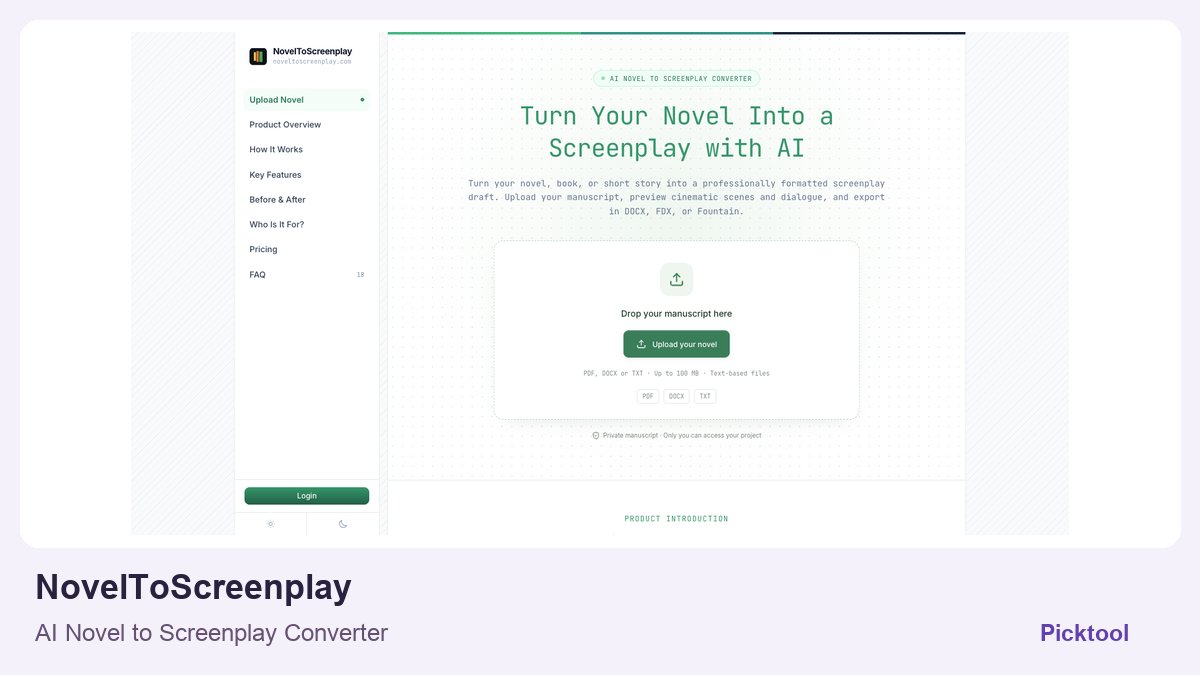
NovelToScreenplay adapts an existing novel or short story into screenplay scenes, visual action and dialogue, then offers DOCX, FDX and Fountain exports. It is a first-draft aid for authors with adaptation rights, not a finished production script. A free opening preview precedes one-time paid packages, whose chapter-revision allowances differ. Unpublished manuscripts are processed by a hosted service and third-party AI providers.
The moment that works best in a novel may be the one a screenplay cannot simply repeat. A narrator can explain years of regret in a sentence; a film needs an image, an action or an exchange that makes the audience understand it. NovelToScreenplay tries to make those adaptation choices from an existing manuscript. Its real value has to be judged in the decisions it makes about the story, beyond whether the page has familiar screenplay margins.
The official workflow accepts text-based PDF, DOCX or TXT files up to 100 MB, and also describes pasting a story. It offers an opening preview before a full conversion. Start with material you own or are authorized to adapt. An upload button does not establish adaptation rights, nor does an AI-generated draft remove that responsibility.
Judge the adaptation, not just the screenplay layout
Choose an excerpt with a clear conflict, a distinctive character voice and at least one internal thought. Examine how those elements become behaviour or dialogue. A character remembering a promise might need a visual object or a new exchange; repeating the thought in voiceover may be an artistic choice, but it should not happen accidentally.
The service advertises tracking story structure, relationships and character references. Treat those as capabilities to assess. Build a small checklist of facts that must remain consistent: names, chronology, what each person knows and which event causes the next. A polished sample page can still contain a serious continuity mistake.
The homepage presents feature-film, television-pilot and short-screenplay use cases. Those forms require different selection and compression. A chapter-by-chapter conversion of a long book may preserve material while producing an impractical film. Decide what the audience must understand, which scenes earn their running time and what can be combined before accepting the generated structure.
Keep a small adaptation brief outside the tool: the central conflict, the point of view, the events that cannot change and the scenes you are willing to compress. Compare the draft with that brief after every substantial revision. A generated character reference can help maintain names and relationships, but it cannot decide whether a scene earns its place in your film. The author still needs to choose what the audience should feel and learn.
For an independent creator, the most useful first output may be a proof-of-concept short instead of an entire feature. Take one self-contained section, revise its dramatic beats and assess whether it works without the narrator explaining everything. We did not generate a script or measure full-manuscript consistency; this is an editorial approach for evaluating the tool.
Budget revisions and test the export in your own editor
On the research date, Opening was $29.90 for one adaptation and twenty AI chapter revisions, Feature was $49.90 with one hundred revisions, and Director's Cut was $69.90 with two hundred. The provider labels these as one-time packages, not a monthly subscription. Compare the included revision room with the length and state of your manuscript rather than treating all packages as equivalent.
The paid offer lists DOCX, FDX and Fountain exports. FDX is relevant to screenwriting software, while Fountain keeps the screenplay in a readable text-based form. Before building a production workflow around either, inspect a sample export in your intended editor for scene headings, dialogue blocks, special characters and page layout.
The revision allowance is about further AI work on the adaptation. Twenty AI chapter revisions should not be read as twenty separate novel conversions. It is worth finding out what counts as a revision before repeatedly regenerating the opening. The published terms also distinguish an unused purchase from one whose paid generation has begun; the free preview is the sensible place to assess whether the adaptation approach suits the manuscript.
What the manuscript terms actually establish
The public privacy summary says manuscripts are processed to generate screenplay drafts and gives a support address for access or deletion requests. It also describes account authentication and analytics. It does not, in the reviewed short page, fully establish manuscript retention, every AI processor or training exclusions. The stated 90-day analytics retention is not evidence that manuscripts have the same retention period.
The terms explicitly discuss third-party AI processing and say the output remains a draft for review. The public privacy summary explains accounts, manuscript processing and access/deletion requests, but it does not fully specify every downstream processor or model-training condition. Its 90-day analytics window should not be reused as a manuscript-deletion promise. An author handling confidential or contracted material should resolve the actual manuscript terms before uploading it.
An author working on an unpublished book should resolve those questions before uploading the full manuscript. A private workspace is about who can access the account project; it is not automatically a promise that processing never reaches an outside provider. For early evaluation, use a non-sensitive passage whose adaptation rights are clear.
NovelToScreenplay is most relevant to someone starting from an existing story and wanting an editable first adaptation. A writer starting from a blank screen, a producer needing production breakdowns or a filmmaker seeking a finished edit has a different problem. Review the free excerpt critically, confirm privacy and revision terms, and expect substantial human rewriting before showing a script to collaborators. Formatting is the beginning of the assessment, not the final quality standard.
What you can do with it
- Novel and short-story adaptation
- PDF, DOCX and TXT manuscript input
- Scene, action and dialogue drafting
- Free opening excerpt preview
- DOCX, FDX and Fountain export
- Package-specific AI chapter revisions
Features are based on the stated evidence level. Confirm current availability and plan limits with the official provider.
Understand the pricing first.
This is a plan description, not a guaranteed numeric price. Check allowances, renewal terms, and exports before paying.
What to check before choosing
Narrative fidelity, pacing and export compatibility need checking. The public privacy page is brief and does not establish every manuscript-retention or model-training condition. One-time packages include limited AI chapter revisions.
Our test method and limits
Public product, pricing and relevant policy/documentation researched on 28 October 2026; editorial narrative revised the same day. Worked budgets and suggested evaluation methods are explanations, not generated-output tests. No account purchase, installation or independent performance benchmark was performed.
Does it fit better than your other option?
Questions before you choose
Does the paid package renew monthly?
The terms describe the current adaptation packages as one-time purchases without automatic renewal. The included AI chapter revisions differ by package; this is not an unlimited adaptation subscription.
Will the result be ready to send to a producer?
The provider’s terms describe a first draft, without promising production, professional acceptance or a finished shooting script. Review dramatic structure, continuity, dialogue, formatting and the rights to the original material before using it professionally.
Sources & check dates
- 1. Official adaptation workflow and package prices ↗ · Checked 2026-10-28
- 2. Official manuscript and account privacy summary ↗ · Checked 2026-10-28
- 3. Official adaptation, third-party AI and package terms ↗ · Checked 2026-10-28
Other tools for a similar task
Compare options ↗Flexnote
Video essayists, course creators and researchers who need to connect source material before writing
StyleTyper
Creators drafting scripts, replies and rough notes by voice in their existing desktop applications
DraftKey
Mac creators polishing short script passages, emails and captions with on-device inference.
Related by creator task. These are options to investigate, not measured winners.