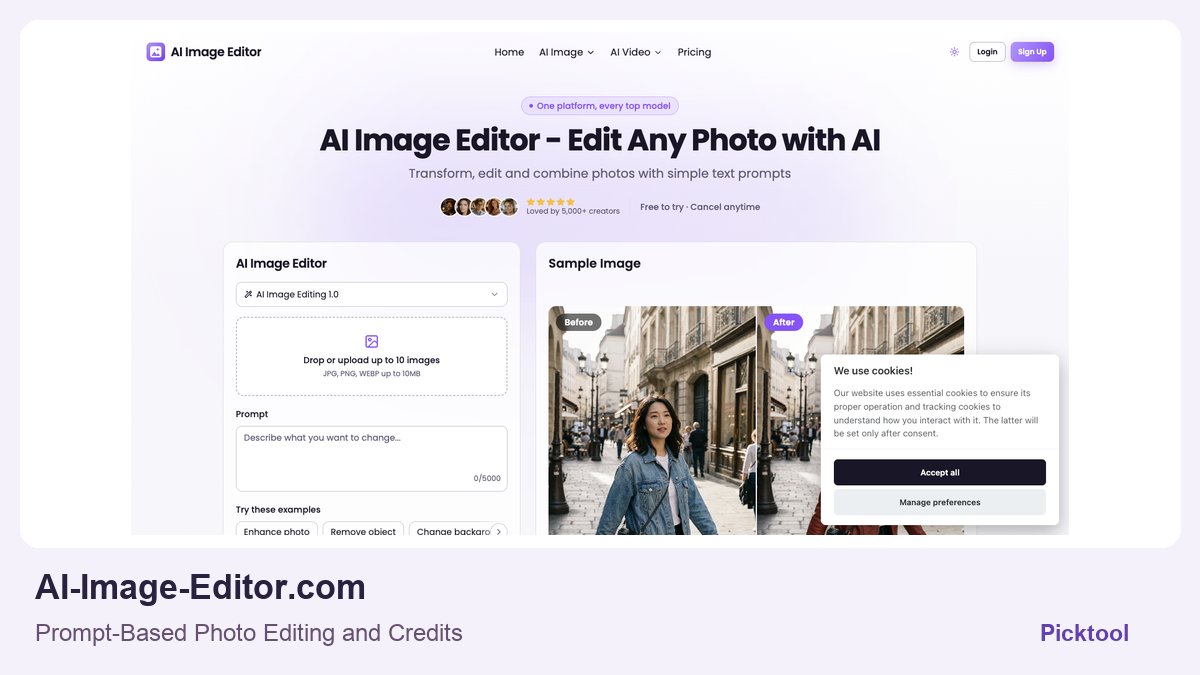
What does AI-Image-Editor.com do?
AI-Image-Editor.com changes existing photos through text prompts and reference images, including backgrounds, restyling and composite scenes. It can help creators explore promotional variations, but rendered pixels are not necessarily editable layers or an exact product replica. Free signup credits and paid allowances depend on the offer and model. Check annual billing totals and hosted processing terms before using client material.
A useful photo edit usually has a clear boundary: change the setting, keep the actual product; improve the lighting, preserve the person; combine references, retain the details the client recognizes. AI-Image-Editor.com provides a prompt-driven interface for those requests. The important assessment is how much control survives the generated revision, not how dramatic a before-and-after example looks.
The visible upload control lists JPG, PNG and WebP inputs, up to 10 MB, and allows multiple images with a displayed maximum of ten. Confirm the active model's requirements before assembling a complex request. A front-page control is not proof that every supported model accepts the same number or type of references.
Define what the AI is allowed to change
Use an image you have permission to process and describe what must remain unchanged. For a product photo, that might be the label, proportions, colour and packaging. Start with a simple background revision and inspect the output closely. A visually plausible replacement can still alter the exact product, which makes it unsuitable for a truthful listing image.
The website advertises character consistency and combining images. Those are useful goals, but they are not a guarantee of pixel-level preservation or identity fidelity. Check faces, fingers, logos, fine text and perspective at full size. We have not generated an image with this service and do not publish a quality score.
Describe both the change and the invariants. For example, a product image may need a new background while its label, proportions and packaging must remain exact. Then compare those details with the original rather than judging the scene as a whole. If the model changes them, a targeted conventional edit may be the better next step. We have not generated an output here, so this is an evaluation method rather than a claim about a measured failure rate.
Credit allowances do not describe every possible output
A prompt-based editor usually gives you a rendered image. That does not establish that the text, objects and shadows will be separate layers in the export. If your client expects a reusable template, check the supported export structure first. A flattened visual may be enough for a single post and inadequate for a design system.
For thumbnail work, create the scene or visual idea first, then place critical typography in a tool where you can control exact words and spacing. Check readability at feed size, not just on a large preview. This suggested workflow reduces reliance on generated small text; it is not a claim that this editor always fails or succeeds at typography.
Separate the plan allowance from the price of the chosen operation. A plan advertising 100 credits and up to 100 images does not establish that every premium model or high-resolution edit costs one credit. Check the actual generation quote and what a retry consumes. For recurring work, estimate how many usable final images you need after revisions, rather than treating every generation attempt as a deliverable.
The homepage advertises free credits on signup, but we did not confirm a stable number or a daily refill. Do not translate a Free to try button into unlimited free editing. Credit usage depends on the chosen operation and model, so the maximum images displayed on a plan should not be treated as a guaranteed number of your preferred high-cost generations.
The pricing page opened in an annual promotional state. For example, the Lite presentation showed a $4.90 monthly equivalent with a $58.80 annual total and 100 credits per month. That is an annual commitment, not evidence of a $4.90 month-to-month subscription. The page also offered monthly billing and credit packs. Recheck the active tab, renewal terms and total before buying; we are not promoting its countdown as an independently verified deadline.
Decide whether a hosted render fits the deliverable
The paid plan presentation lists private generation, but the privacy policy still describes uploaded images, video materials, prompts, settings and generated results as processed information. It names Supabase for storage and permits sharing with operational service providers. A result being private from other users does not imply that the service runs only on your device.
The reviewed policy uses a general retention standard rather than a specific automatic image-deletion deadline. Before submitting unreleased products or a client's portrait, establish the applicable permissions and decide whether the service's processing conditions fit the project. Do not infer a no-training commitment from the absence of a public gallery.
Consider this editor if you want a hosted interface for reference-based revisions and are comfortable with its credit model. If you need exact layered layout, guaranteed identity preservation or offline processing, the verified public information does not establish those outcomes. Test one authorized, non-sensitive image, compare the result with the original and inspect the actual credit quote before planning a client workflow around it.
What you can do with it
- Text-prompt image revisions
- Multiple-image reference input
- Background and object changes
- Image-to-image restyling
- Photo enhancement workflow
- Model- and plan-dependent generation
Features are based on the stated evidence level. Confirm current availability and plan limits with the official provider.
Understand the pricing first.
This is a plan description, not a guaranteed numeric price. Check allowances, renewal terms, and exports before paying.
What to check before choosing
Not an offline editor. The policy covers uploads, prompts and generated results and allows service-provider processing. Annual promotional rates are not month-to-month prices. Exact free credit count and output cost vary or were not verified.
Our test method and limits
Public product, pricing and relevant policy/documentation researched on 28 October 2026; editorial narrative revised the same day. Worked budgets and suggested evaluation methods are explanations, not generated-output tests. No account purchase, installation or independent performance benchmark was performed.
Does it fit better than your other option?
Questions before you choose
Will the download contain editable text and object layers?
The verified workflow produces rendered image results. We have not confirmed a layered design-file export. Ask for an example export if a reusable template is part of the client deliverable.
Does a private-generation label mean no provider processes my photo?
No. The policy covers uploads, prompts and outputs and describes operational service providers. Private visibility to other users and the service’s processing of the image are different questions.
Sources & check dates
- 1. Official input controls and editing workflow ↗ · Checked 2026-10-28
- 2. Official plan and billing presentation ↗ · Checked 2026-10-28
- 3. Official upload, prompt and retention policy ↗ · Checked 2026-10-28
- 4. Official recurring plans, credits and service terms ↗ · Checked 2026-10-28
Other tools for a similar task
Compare options ↗Ricalco
Ecommerce creators, localization agencies and brands adapting finished product graphics for additional markets
Pixolm
Creators preparing product scenes, promotional images and thumbnail concepts that need localised revisions
UseIt Studio
Designing creator stickers, cards, packaging and merchandise
Related by creator task. These are options to investigate, not measured winners.