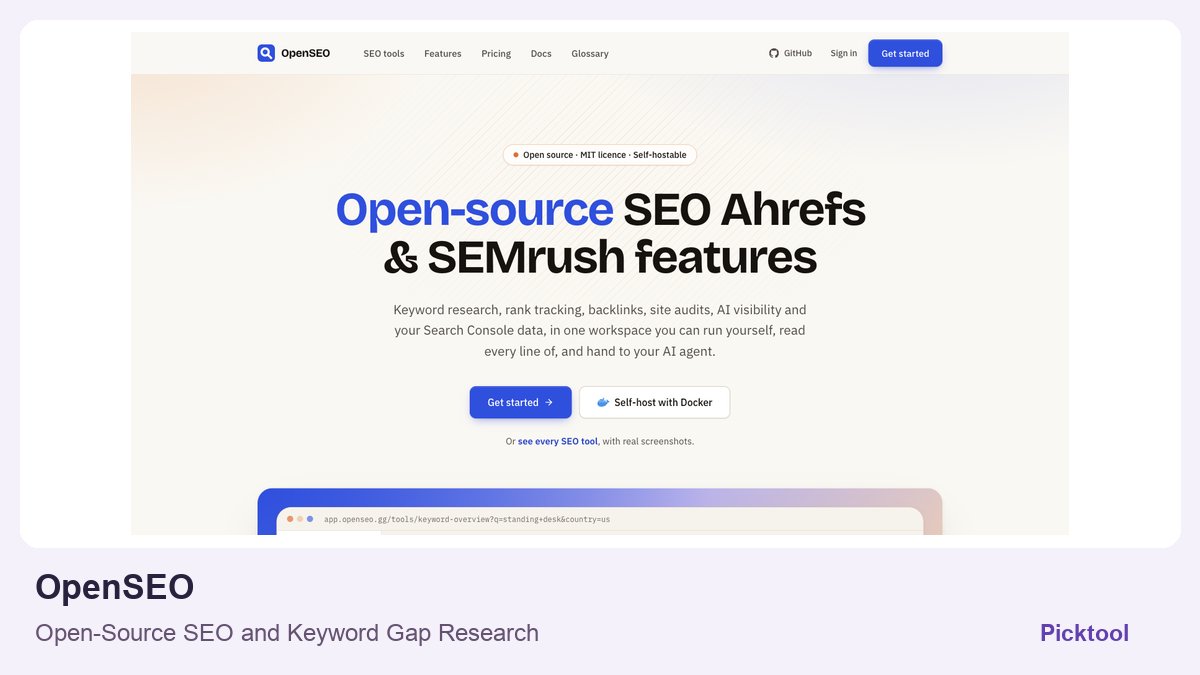
What does OpenSEO do?
OpenSEO is an open-source workspace for keyword research, competitor gaps, technical audits, rank tracking and AI visibility. It organizes data obtained through your own YepAPI key rather than operating an independent search-data index. It can suit technical content businesses that want transparent costs and self-hosting. Software licensing, provider lookups and hosting are separate expenses; a measured mention is not a guaranteed ranking.
A search tool is useful when it helps you decide what deserves attention next. That may be an unanswered reader question, a weak page or a technical problem, rather than another export containing thousands of keywords. OpenSEO brings those jobs into a workspace you can inspect and run yourself. Its distinguishing cost model is also its main buying question: the application is open source, while fresh research data often has a separate bill.
The official site identifies YepAPI as the provider for much of its keyword, ranking and backlink data. You supply the account and key; paid calls are billed by that provider. A limited-time signup credit advertised by a separate provider is not a permanent OpenSEO allowance and is not a Picktool discount. We did not register for it or spend research credits.
Use the research to make an editorial decision
A creator could begin with a specific task such as adapting a manuscript or translating product graphics, then inspect the pages and queries competing for that intent. OpenSEO advertises keyword ideas, questions, SERP results and competitor gaps. Use those views to identify something a reader still needs explained, not simply a list of phrases to repeat.
An apparent gap might be an unclear file limit, the difference between an annual price and monthly billing, or whether a free allowance resets. Those questions can make a stronger article than another generic best-tools list. Any keyword volume or difficulty shown by a data service is an estimate tied to a market and method; it is not a prediction of what Picktool will rank for.
The architecture documentation makes the division of responsibility explicit. OpenSEO handles the dashboard, API, cache, scheduled worker and its own crawler; YepAPI supplies the external search and AI data. Research is grouped by project and market. Keep the same country, language, search depth and device when comparing results, because changing those conditions can change what you are measuring rather than reveal a real gain or loss.
A small lookup becomes a budget when it repeats
The cost documentation explains rank checks by search depth, keyword count, device and schedule. It lists $0.02 for a top-twenty check at the observed provider rate, with deeper checks costing more. A tracker covering desktop and mobile is doing separate checks. Multiplying a small lookup by many keywords and daily runs changes the total materially.
AI answers use variable token-based pricing and can add web-search charges. The documentation provides minimum and expected costs rather than a fixed universal price. Keyword and domain results have their own cache periods; fresh rank checks and AI visibility runs are specifically not reused in the same way because their purpose is to observe change.
For an allowance example, four keywords checked on desktop and mobile every day for thirty days create 240 checks. At the documented top-twenty rate of $0.02 per check, that is $4.80; at $0.10 for top one hundred, the same schedule is $24. These calculations use the observed provider rates and exclude other jobs, hosting and any price changes. The useful budgeting unit is keywords × devices × frequency × depth, not a single attractive per-check figure.
OpenSEO documents a UTC calendar-month spending cap and per-call ceilings for agent and API operations. It also states that requests already in flight can finish after a monthly limit is reached. An AI response has an uncertain final cost, so an answer can take a run over its expected ceiling. Those qualifications belong alongside any claim that an agent cannot overspend.
Start with a small account budget, a short list of valuable queries and a low-frequency schedule. Review the actual usage before expanding. If a request times out after it may have reached the provider, manually retrying can create a second bill; the documented retry behaviour is deliberately cautious for that reason.
What the workspace can and cannot prove
The plain site crawler is documented as free, with limits for the number of pages. Separate rendered checks and performance services can have their own costs. Connecting Search Console is advertised as another workflow, but that requires account authorization and a verified property. We did not connect OpenSEO to Picktool or grant it access during this research.
The AI visibility features can record mentions and citations under selected conditions. A model mentioning a brand in one answer is different from reliable visibility across real user prompts. Save the question, model, search setting, market and date, then compare repeat observations rather than declaring a ranking improvement from one screenshot.
Compare Findrix for another approach to monitoring AI brand mentions and sources. ↗
It is most relevant if you want source access, configurable infrastructure and a direct relationship with the data bill. It is less straightforward for someone expecting a fully managed, unlimited service with no API setup. We checked the public product, cost documentation and repository identity; we did not install the software, validate dataset coverage or run keyword queries. Evaluate a small real research task before replacing an established SEO subscription.
What you can do with it
- Keyword ideas, questions and market selection
- Competitor keyword-gap research
- Technical site audits
- Rank tracking by device and location
- AI mention and citation checks
- MCP/REST interfaces with spending controls
Features are based on the stated evidence level. Confirm current availability and plan limits with the official provider.
Understand the pricing first.
This is a plan description, not a guaranteed numeric price. Check allowances, renewal terms, and exports before paying.
What to check before choosing
Provider estimates are not guaranteed Google traffic. Fresh rank and AI checks can bill each run; self-hosting and API data are separate costs. Concurrent calls and an individual AI answer can exceed a configured estimate within documented conditions.
Our test method and limits
Public product, pricing and relevant policy/documentation researched on 28 October 2026; editorial narrative revised the same day. Worked budgets and suggested evaluation methods are explanations, not generated-output tests. No account purchase, installation or independent performance benchmark was performed.
Does it fit better than your other option?
Questions before you choose
Does OpenSEO have its own complete backlink and keyword index?
The official architecture says it is a workspace and obtains the external search, domain and backlink data through YepAPI. Dataset coverage and freshness therefore need to be assessed with that provider relationship in mind.
Does an AI visibility result prove that real customers will find me?
No. It records configured questions and answer surfaces at a point in time. Keep the prompt, model, search mode, market and date, and evaluate actual referrals or conversions separately.
Sources & check dates
- 1. Official product and data-provider explanation ↗ · Checked 2026-10-28
- 2. Official costs, caching and limits ↗ · Checked 2026-10-28
- 3. Official open-source repository ↗ · Checked 2026-10-28
- 4. Official data flow, project markets and background runs ↗ · Checked 2026-10-28
Other tools for a similar task
Compare options ↗ahaboard
Adult learners and educators exploring explanations visually before preparing their own lesson materials
Elmo
Creator businesses and agencies monitoring whether specific buyer questions surface their brand or competitors
ScribeCrate Live
Technical creators and small teams building controlled live captions or speech-to-text into their own applications
Related by creator task. These are options to investigate, not measured winners.