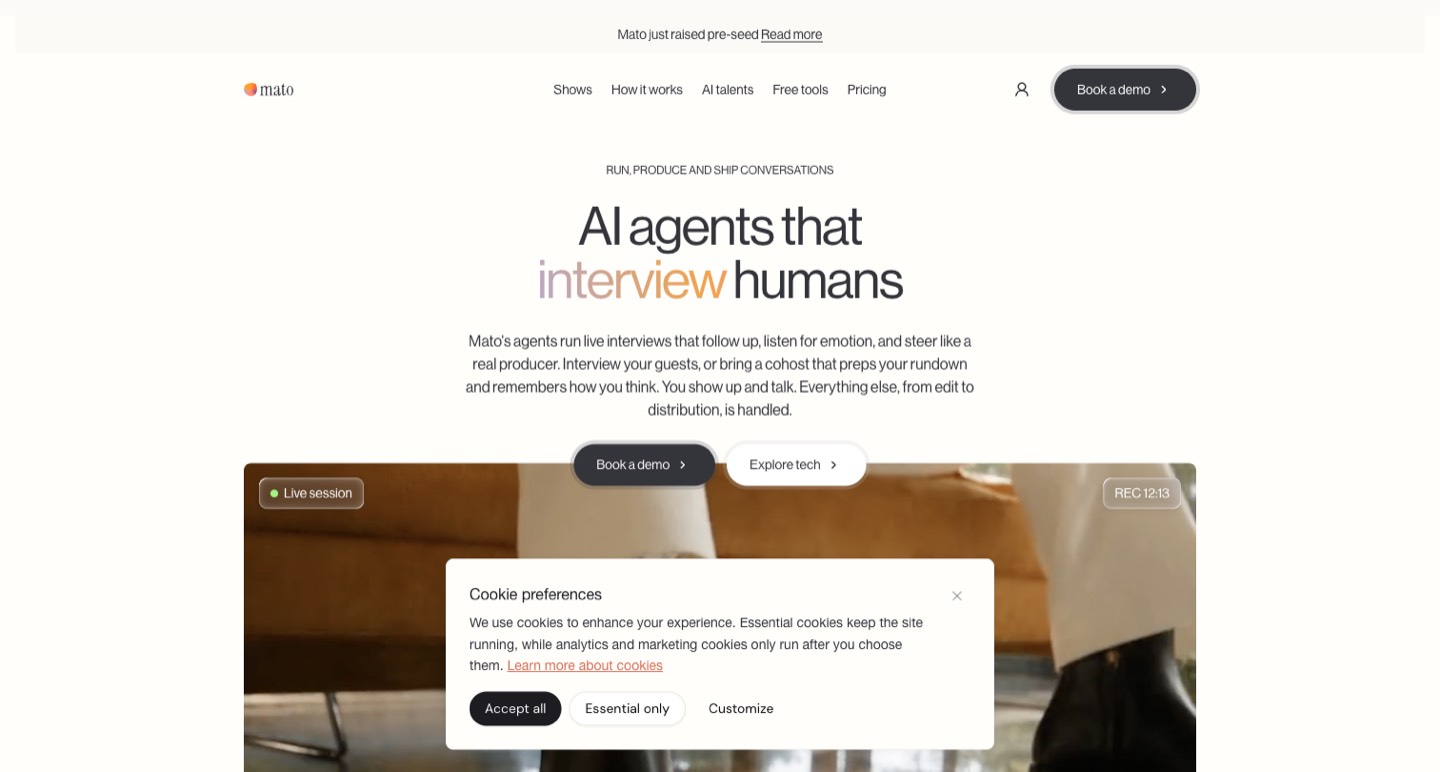
For a real-guest AI interview, verify that the chosen plan includes live interviews rather than only AI discussions. Mato currently lists live guest interviews on Business at $3,500 per month plus $50 per published episode; assess that against an approved pilot and your production needs.
An AI podcast host can mean several different things. It might generate a discussion between synthetic speakers, read an existing script, or conduct a conversation with a real guest. Those are different editorial products with different risks, budgets and preparation. Decide which one your audience needs before comparing a monthly price or an automation claim.
Mato's current pricing page separates AI discussion and topic episodes on Launch from live AI interviews with real guests on Business. At the time of this check, Launch is listed at $1,200 per month and Business at $3,500, each with a $50 published-episode fee. Those figures are vendor prices, not evidence of a return on investment. The workflow below is an evaluation plan; Picktool did not conduct a paid Mato interview for this article.
Read the Mato review for its broader source-based assessment. ↗
Match the mode to the editorial goal
Write a one-sentence purpose for the show. A proposed interview with an experienced customer should reveal that person's decisions and examples, not manufacture a generic discussion about the industry. An explanatory topic episode may serve another purpose and should be labeled accordingly. A real person's participation and an AI-generated conversation should never be presented to listeners as interchangeable evidence.
Ask the provider to demonstrate the exact mode and deliverables you intend to buy. For a real-guest interview, evaluate how the host handles a short answer, an unexpected claim and a guest who corrects the premise of a question. A smooth introduction is not enough. The useful question is whether the conversation develops an accurate, specific idea without putting words in the guest's mouth.
Mato describes preparation based on the guest and brief, followed by production and distribution stages. Supply a concise approved brief, important background sources and topics that require care. Do not give an automated host confidential research it is not authorized to process. Tell the guest what system will conduct the interview, how recording works and how the finished episode will be reviewed.
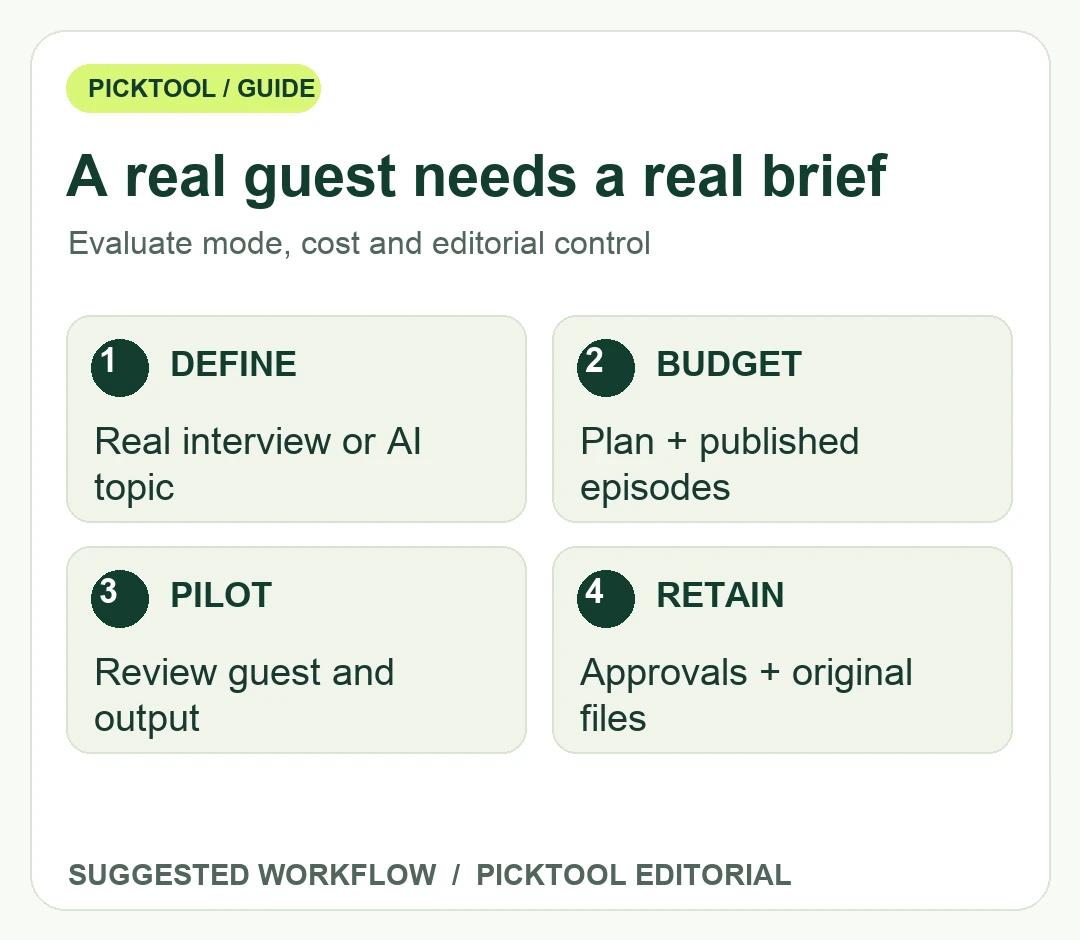
Calculate the budget from published episodes
Use the subscription, intended publication count and any additional requirements as separate budget rows. Using the currently listed Business price, four published episodes would produce a simple monthly estimate of $3,700: $3,500 plus four publication fees of $50. That calculation excludes taxes, negotiated terms and any additional services. It is not a claim that four episodes are included, a checkout quote or a performance forecast.
Allocate human time as well. Someone still needs to approve the brief, coordinate permissions, review the conversation, check claims, inspect the final files and decide what should be published. Automation may change where that work happens, but it does not make editorial responsibility disappear. Record the actual work required by your pilot before extrapolating savings across a full season.
The current plan page also distinguishes clip-credit allowances and other capabilities. Confirm what a credit buys and which deliverables are included before treating a large credit number as a guaranteed number of usable social clips. Ask how revisions, unpublished drafts and cancellation affect the work you intend to keep. Preserve the written answer with the project budget.
Define a pilot that can fail usefully
Choose an authorized guest and one narrow subject rather than a high-stakes announcement. Write acceptance criteria before the session: factual preparation, relevant follow-up questions, accurate representation of the guest, acceptable audio, a reviewable transcript and a usable export. Decide who has publication approval and what happens if the pilot does not meet those criteria. Do not publish merely because a generation or production job completed.
Review the transcript against the actual recording. Flag unsupported factual claims, changed names, sensitive details and passages that sound like an endorsement the guest did not give. When making edits, preserve meaning and use a clear approval process. The fact that a host is synthetic does not make the real guest's words fictional or remove the need for ordinary interview care.
Listen to the finished audio separately from reading the transcript. Check interruptions, awkward pauses, pronunciation, transitions and whether the listener can follow who is speaking. Inspect show notes, titles and clips too: a careful episode can be undermined by a misleading summary. Mato says it discloses the AI host in the show notes and introduction; verify the actual disclosure in your own deliverable.
Finally, confirm ownership, access and export arrangements for the feed, recordings, transcripts and artwork. Mato's how-it-works page says customers can take their show and masters with them when leaving, while its privacy policy describes processing interview material. Ask how that works for your account and keep your own authorized copies. A provider statement is a starting point for verification, not a completed migration test.
Choose the service if the specific mode, pilot quality and economics fit the show. Choose a simpler human-led recording workflow when the value is your own interviewing style or when the recurring budget exceeds the production need. Evaluate actual audience response after publication without importing a vendor's sales or completion-rate claims as results for your show.
Browse podcast tools by their actual role in preparation, recording and production. ↗
Sources & check dates
- 1. Mato current plan modes and publication fees ↗ · Checked 2026-10-28
- 2. Mato preparation, AI hosting and production stages ↗ · Checked 2026-10-28
- 3. Mato recording and interview-data privacy policy ↗ · Checked 2026-10-28