
Recraft currently says Free-plan images are public, owned by Recraft and not licensed for commercial use. Paid-plan images generated while subscribed receive the stated ownership and commercial rights. Check the plan and creation date of each asset rather than assuming a later upgrade covers earlier work.
An image that downloads successfully is not automatically cleared for a paid campaign, a client website or a product package. Before choosing an AI design tool, separate three questions: whether the file meets the design brief, what the service contract permits, and whether other rights or permissions are still needed. A useful commercial-use check follows the individual asset, not just the current status of an account.
Recraft's current pricing FAQ draws a clear distinction. It says Free-plan images are public, owned by Recraft and not licensed for commercial use. It describes ownership, commercial rights and privacy for images generated while a paid subscription is active, with those rights continuing after cancellation. Its current terms are dated 21 October 2026. Read the current documents when using this guide; a summary is not a legal clearance opinion for a particular project.
Read the Recraft review for its design features and the source-based review boundary. ↗
Attach the permission record to the asset
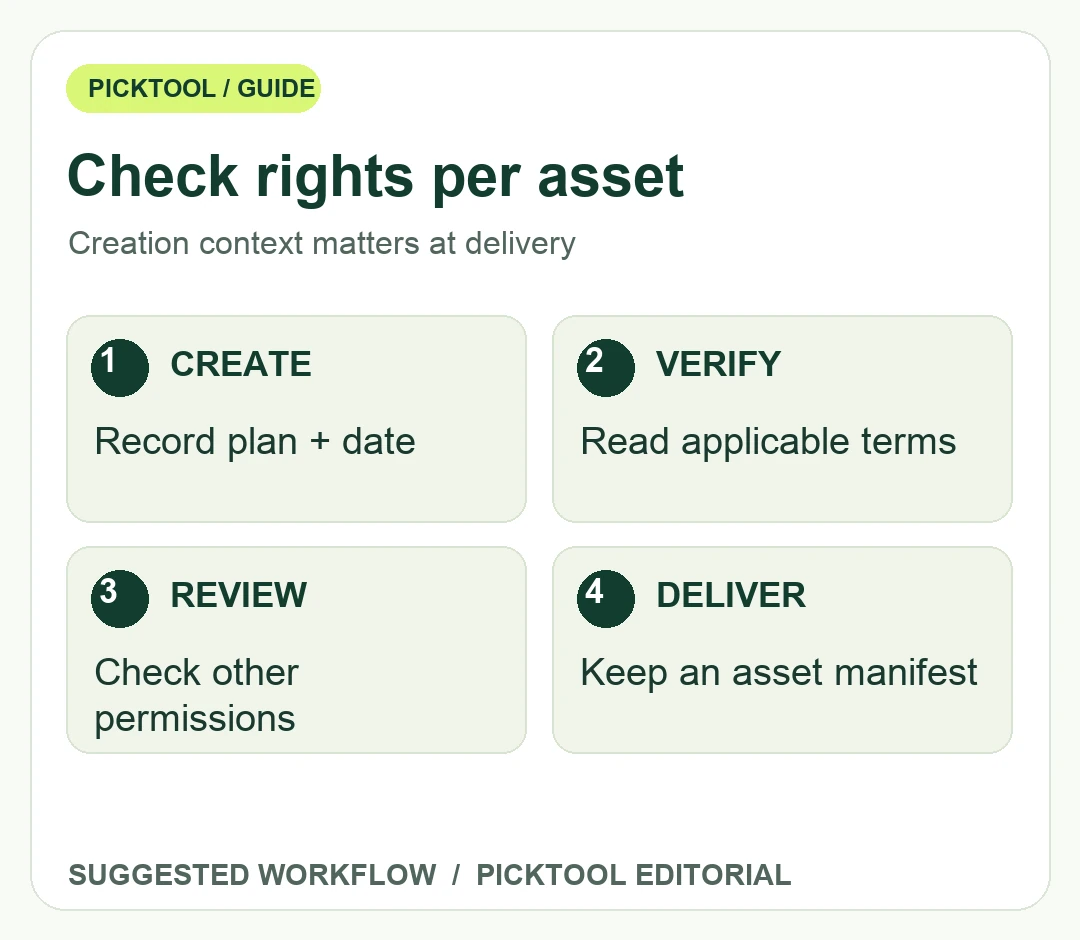
For every image considered for client work, record the generation date, account or workspace, plan in force at creation, project identifier and relevant terms. Keep the original export and the proof of the applicable subscription with the project archive. These are suggested production records, not a claim that Recraft exports a ready-made clearance certificate.
Do not assume that paying today changes the status of an image made earlier on a different plan. The official FAQ describes rights for images generated while subscribed. If you want to reuse a Free-plan asset commercially, obtain a clear answer from the provider about that asset or create a new qualifying asset under the appropriate terms. An upgraded account badge alone does not resolve the historical question.
For a proposed client landing page, the design review and the permission review should be separate sign-offs. A designer can approve composition and legibility while a project owner checks the asset record and intended use. If either record is missing, use a clearly labeled internal placeholder rather than silently sending it as an approved final deliverable. This avoids confusing a visually finished draft with a cleared production asset.
Separate commercial permission from exclusivity and other rights
A service's commercial-use permission answers a contractual question about that service. It does not, by itself, establish that the output is unique, eligible for a particular form of intellectual-property protection, or free of every third-party issue. Review references, recognizable people, logos and supplied client materials separately. Ask the responsible rights owner or a qualified adviser when the intended use requires a legal determination.
Recraft's privacy distinction also matters for an unreleased campaign. A public-gallery workflow can reveal an idea before the client is ready to announce it. Confirm the applicable workspace and creation settings before submitting confidential inputs. Do not test privacy with the confidential material itself. Use a harmless sample to understand what is visible and which plan governs the project.
If several people contribute assets, use a shared manifest with one row per image rather than a blanket note saying all visuals are AI licensed. Include who supplied the source reference, which file is approved, and where it may be used. A creator might have permission for a website graphic but need a separate conversation about merchandise or a client's supplied brand elements. The manifest makes that discussion concrete without pretending to settle it automatically.
Check the file as carefully as the terms
Once the permission record is satisfactory, inspect the actual export. Open it in the application that will receive it. Verify dimensions, transparency where required, color appearance and any small lettering. If you need vector artwork, inspect its paths and editability in the destination tool instead of assuming every file with a vector extension is easy to modify. This is a proposed acceptance check, not a benchmark of Recraft output.
For a thumbnail, test the design at the intended small display size. For packaging, ask the printer or production partner for their specifications before final delivery. A polished web preview cannot establish print readiness. Preserve an editable source where your workflow allows it, and keep the approved final export separate from rejected variations.
Recraft's pricing FAQ also distinguishes subscription credits from separately purchased API units. If your workflow moves from the web application to an integration, review that billing and contractual route independently. Do not assume a paid web subscription covers every automated call or that an unused balance makes every kind of purchase refundable. Confirm the current quote before spending.
The useful decision is therefore asset-specific: the right plan at the right time, documented permissions for the intended use, and an export that meets the production brief. If one part is unresolved, state it plainly. A factual rights checklist is more valuable to a client than a broad label such as commercially safe applied to every image in a folder.
Explore SurgePix when your next decision concerns editing layers and a brand-kit workflow. ↗
Questions & answers
Does a later upgrade automatically clear older Free-plan images?
The current FAQ describes rights for images generated while a paid subscription is active. Do not assume retroactive coverage; confirm the status of the specific older asset with Recraft.
Sources & check dates
- 1. Recraft current pricing, ownership and cancellation FAQ ↗ · Checked 2026-10-28
- 2. Recraft terms effective 21 October 2026 ↗ · Checked 2026-10-28
- 3. Recraft official product formats and workflows ↗ · Checked 2026-10-28