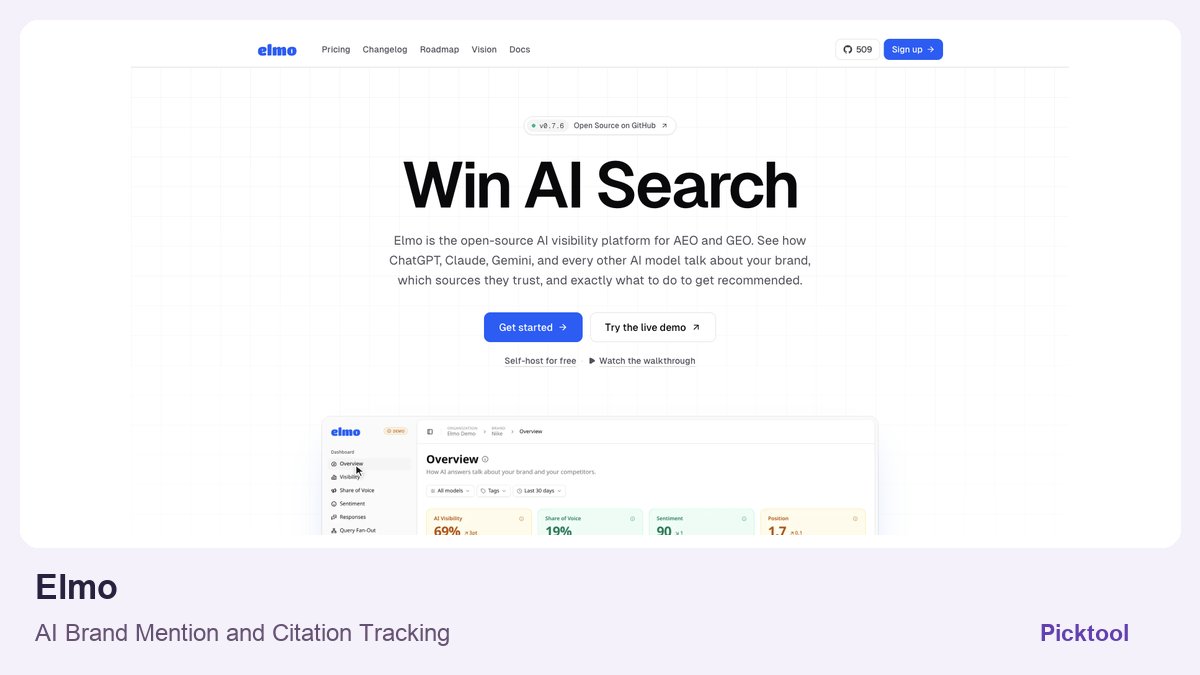
An AI brand mention is a reference to your brand; a citation links or attributes an answer to a source; a visit is a separate observed action. Track them separately using a stable prompt sample and saved answer evidence. Elmo can monitor AI visibility, but a sampled answer is not a universal search ranking.
A screenshot showing your brand in one AI answer can be encouraging, but it does not establish that you rank first, receive qualified visits or appear for everyone asking a related question. A useful visibility program begins by deciding what you are measuring and preserving the answer that supports each observation. Otherwise a dashboard can make a small, changing sample look more conclusive than it is.
Elmo's public repository describes an open-source platform for tracking brand mentions and citations across several AI services. Its self-hosting documentation lists infrastructure and separate provider-key requirements. This article proposes a measurement design rather than claiming we deployed Elmo or measured a Picktool campaign with it. Google also says established SEO fundamentals apply to its AI features; a special AI file or schema is not a guaranteed inclusion route.
Read the Elmo profile for product scope, hosting and current official documentation. ↗
Define three outcomes before creating a score
Use a mention to describe whether the answer refers to your brand. Use a citation to describe whether the answer attributes information to a source, recording the actual linked destination where one is present. Use a visit to describe traffic observed in your own measurement system. These are working definitions for a transparent report, not a claim that every vendor calculates them identically.
A brand can be mentioned without its website being linked. A competitor or directory can receive the citation for a sentence about your product. A linked answer may produce no measurable visit, while some visits may have limited referral information. Keep those outcomes in separate columns instead of adding them into an unexplained authority score.
For a hypothetical creator tool, a prompt about offline drafting may mention the product, while a prompt about pricing may cite an old directory. Those observations suggest different editorial tasks: improve the task explanation in one case and check the public pricing source in the other. Neither observation proves that a particular page edit will cause the next AI answer to change.
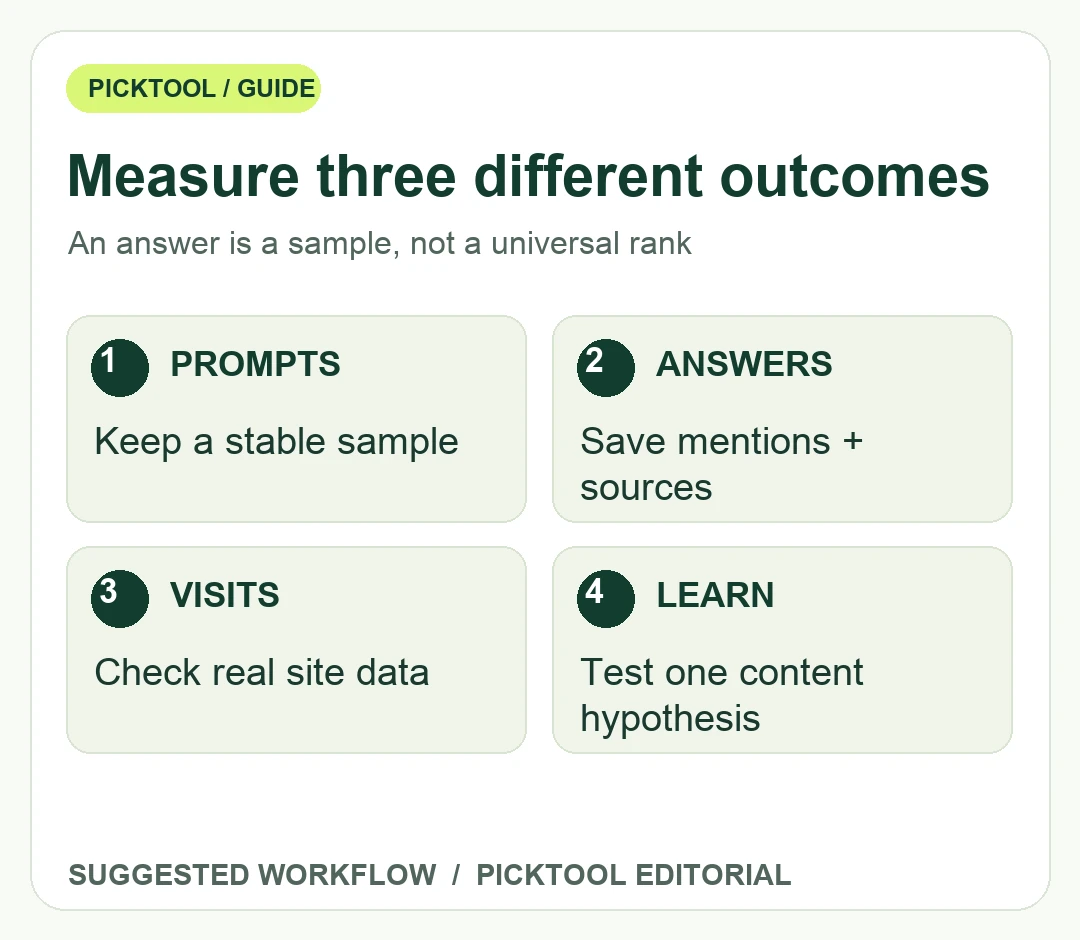
Keep the measurement columns separate.
| Observation | Record | Do not infer |
|---|---|---|
| Brand mention | Exact answer text and brand reference. | A linked citation or a visit. |
| Citation | Attributed source and actual destination URL. | A recommendation or a conversion. |
| Website visit | Observed session or event with its measurement limits. | That one prompt or edit caused it. |
Build a stable, representative prompt sample
Start with the decisions your audience actually faces. Separate branded questions, task questions and comparisons. Record the exact prompt, language, market context, service, model or mode where available, run time and answer evidence. If the test uses an API, label it as an API sample rather than assuming it reproduces every answer in a consumer application.
Keep the core prompts stable long enough to compare runs. You can add a new topic, but mark it as a new sample instead of blending it into the old trend without explanation. Use a small set you can review carefully before scaling. A hundred vague prompts can produce more activity while teaching less than a handful of questions tied to real buyer decisions.
Save the response and citation destinations with each observation. Check ambiguous brand names manually and distinguish a favorable, neutral or critical reference from a simple word match. If an answer cites a URL that no longer resolves or attributes a claim to an unrelated page, record that issue. Do not silently turn every matching phrase into a successful recommendation.
Elmo's self-hosting documentation requires server components and AI-provider access, including keys for the configured routes. An open-source license does not make hosting or provider usage free. Estimate runs as prompts multiplied by services and repetitions, then check the billing model for those providers. Do not infer API credit from a paid consumer chatbot subscription.
Turn observations into specific content work
When a repeated answer gets a product fact wrong, first inspect the current official page and the cited source. Is the information accessible as text, dated truthfully and explained clearly? Does the page answer the question before requiring the reader to infer the result from feature labels? Correct the underlying content with evidence rather than adding repetitions of a target phrase.
Keep the technical basics separate from the editorial hypothesis. A page should be crawlable, indexable where intended, internally discoverable and consistent in its visible facts and metadata. Those conditions make a page eligible for understanding and retrieval; they do not force a particular answer or citation. Google's AI-feature guidance explicitly rejects the need for a special optimization file or special structured-data type for inclusion.
For a small website, compare the visibility sample with Search Console and consented website analytics without pretending they measure the same thing. Search impressions, sampled AI answers and site visits have different scopes and reporting delays. A short history with a few observations is useful as a starting baseline, but too small for a reliable causal claim or percentage ranking forecast.
Write each recommendation as a testable hypothesis: clarify an outdated limit, add a useful workflow example, fix an inaccessible source link or connect a relevant guide. Record the publication date and later observations. If the answer changes, consider other changes in the service and the wider web before crediting the edit alone. This produces a report another person can audit rather than a promise that an optimization package guarantees AI visibility.
Questions & answers
Does appearing in one AI answer establish a search ranking?
No. Record the service, prompt, mode and time as a sampled observation. Mentions, citations and website visits should be reported separately, with their respective limitations.
Sources & check dates
- 1. Elmo official self-hosting requirements and provider access ↗ · Checked 2026-10-28
- 2. Elmo maintainer repository and visibility-tracking scope ↗ · Checked 2026-10-28
- 3. Google guidance for AI features and website eligibility ↗ · Checked 2026-10-28
- 4. Google people-first content guidance ↗ · Checked 2026-10-28